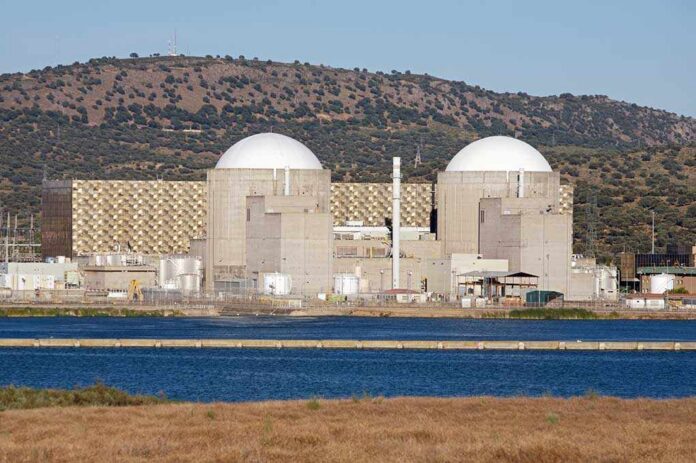
Finland’s deep repository is moving from promise to practice, aiming to lock away spent nuclear fuel for longer than recorded history says any institution has ever lasted.
Story Snapshot
- Engineers will seal spent fuel over 400 meters deep using copper canisters, bentonite clay, and hard bedrock.
- Finland follows the KBS-3 method also used by Sweden, with disposal tunnels at 400–700 meters.
- Regulators review safety at every step, separate from the operator’s claims.
- Commissioning trials moved dummy fuel through the full chain ahead of operations.
What Finland Is Building Underground
Posiva’s Onkalo facility on Finland’s west coast is designed for final disposal of spent nuclear fuel. Engineers plan to place fuel assemblies inside a copper canister with an iron insert. Workers then set each canister in compacted bentonite clay, surrounded by crystalline bedrock more than 400 meters below ground. The copper shell serves as a corrosion barrier, while the clay limits water flow and movement. The bedrock adds stability and isolation over long timescales.
The overall design follows the KBS-3 concept used by Finland and Sweden. This method calls for disposal at 400 to 700 meters below ground in stable crystalline rock, with backfilled tunnels and engineered plugs. Finland’s government chose Olkiluoto for disposal in 2000, and Parliament ratified that policy in 2001. The approach relies on multiple barriers that work together rather than on any single layer to block releases.
How Oversight Works and Why It Matters
Finland’s Radiation and Nuclear Safety Authority reviews safety at each license stage and advises the Government, which issues licenses. The regulator evaluates the repository’s ability to limit releases during operation and after closure. That includes how canisters, clay, plugs, and bedrock perform over long periods. The regulator’s process sets conditions the operator must meet before advancing to the next step. This separates safety judgment from company claims and schedules.
The project has advanced through years of policy, siting, and construction steps. International reporting records that Finland issued a construction license in 2015. Later, the encapsulation plant was commissioned, and workers tested the system with dummy fuel in five canisters that moved to the underground facility. That dry run showed that critical handling, sealing, and transport steps can work at scale before any radioactive fuel is emplaced.
What Operation and Closure Will Look Like
The International Atomic Energy Agency reports that Onkalo lies roughly 400 to 450 meters deep and will receive spent fuel for about a century. After the final canister is placed, crews will seal the tunnels and shafts. The safety case does not depend on constant human care after closure. Instead, it counts on the passive protection of copper, clay, and rock to slow and block the spread of radionuclides far beyond any normal planning horizon.
The first engineered structure built to last for 100,000 years is about to begin operations. The hope is that Onkalo, deep below ground in Finland, will offer a safe place for the country to store nuclear waste https://t.co/6y2becTcA8
— New Scientist (@newscientist) November 3, 2026
One important caveat is that the central promise reaches across a timescale no society can witness. The long-term claim rests on models, experiments, and conservative design choices rather than direct observation over 100,000 years. That said, geological disposal remains the option that many technical institutions judge most credible as a permanent solution using today’s technology, even as siting, cost, and public acceptance remain tall hurdles in many countries.
Why This Matters Beyond Finland
Energy policy in the United States and Europe keeps running into the same obstacle: what to do with spent fuel. Finland’s build-out offers a working template and a test case others will watch. The milestone shows that a country can make decisions, fund a solution, and put waste on a path to isolation. For readers who worry that elites delay hard choices while problems grow, this project is a rare example of follow-through backed by clear oversight and engineering discipline.
Sources:
newscientist.com, washingtonpost.com, ans.org