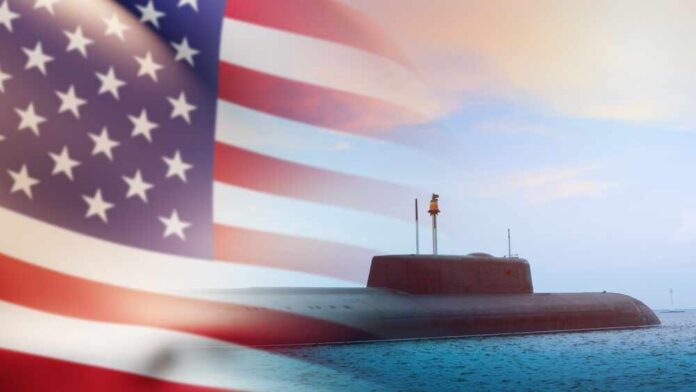
The U.S. Navy’s $348 billion Columbia-class submarine program races toward 2030 delivery while taxpayers shoulder unprecedented costs for a nuclear deterrent that officials claim will prevent World War III—yet critics question whether this massive investment serves the American people or perpetuates a defense spending cycle that enriches contractors while ordinary citizens struggle with inflation and economic uncertainty.
Story Snapshot
- Columbia-class program reaches 60% completion with first submarine operational by 2031, replacing aging Ohio-class fleet at $348 billion total cost
- Advanced electric drive propulsion and X-shaped stern design promise unprecedented stealth capabilities for nuclear missile submarines
- Navy prioritizes 12-boat fleet over other programs despite budget strains affecting taxpayers and potential gaps in conventional naval capabilities
- General Dynamics Electric Boat leads construction while program’s massive price tag raises questions about fiscal responsibility amid national economic challenges
Unprecedented Investment in Nuclear Deterrence
The U.S. Navy designated the Columbia-class submarine program in December 2016 as its top acquisition priority, with construction of the lead boat USS District of Columbia beginning in October 2020. The program aims to replace 14 aging Ohio-class submarines with just 12 new vessels, each measuring 560 feet long and displacing 20,810 tons submerged. General Dynamics Electric Boat serves as prime contractor, with HII Newport News Shipbuilding providing design support. The 2018 Nuclear Posture Review mandated this force structure to maintain continuous at-sea deterrence capabilities through the 2080s, ensuring America’s second-strike nuclear retaliation ability remains credible.
Revolutionary Stealth Technology at Massive Cost
Columbia-class submarines incorporate turbo-electric drive propulsion systems that eliminate traditional mechanical linkages between reactor and propeller, significantly reducing noise signatures compared to Ohio-class predecessors. The innovative X-shaped stern configuration enhances maneuverability while maintaining acoustic stealth. Each submarine features a “life-of-core” reactor requiring no refueling during its 42-year service life, supporting approximately 124 patrols per boat. These vessels will carry 16 Trident II D5LE submarine-launched ballistic missiles, forming the sea-based leg of America’s nuclear triad alongside bombers and intercontinental ballistic missiles. Defense analysts tout these innovations as essential for countering advanced anti-submarine warfare capabilities from adversaries like China and Russia.
Budget Priorities Reveal Troubling Trade-Offs
The Navy’s commitment to Columbia-class funding forces difficult choices that impact conventional defense capabilities and taxpayer burden. With the program consuming significant portions of the shipbuilding budget, other critical acquisitions face potential delays or reductions. Shipyard workers in Groton, Connecticut, and Newport News, Virginia, benefit from employment, yet Americans nationwide shoulder the $348 billion price tag through federal spending during an era of persistent inflation and economic strain. The Submarine Industrial Base Council promotes these investments as boosting manufacturing, but skeptics question whether such massive expenditures truly serve national interests or primarily enrich defense contractors. This represents a familiar pattern where government officials prioritize programs with powerful industry backing while ordinary citizens struggle with rising costs and diminished economic opportunity.
Operational Timeline and Strategic Concerns
Navy officials report the program remains on track despite cost concerns and previous delays, with the first boat scheduled for 2030 delivery and operational status by 2031. Secretary of the Navy Carlos Del Toro announced the naming of USS Groton as SSBN-828 in January 2026, signaling confidence in program momentum. However, any delays risk creating gaps in deterrence coverage as Ohio-class submarines, which entered service in 1981, reach the end of their extended service lives. Each Columbia-class submarine will accommodate 155 crew members and provide unlimited range for global patrols. The vessels’ 42-year service life aims to sustain mutual assured destruction doctrine—the Cold War-era concept that peace stems from guaranteed annihilation—well into the next century, raising questions about whether this approach addresses 21st-century security challenges or perpetuates outdated military strategies favored by entrenched defense establishment interests.
The U.S. Navy’s New Columbia-Class Stealth Submarine Is Built to Fight a Nuclear World War IIIhttps://t.co/R7kECTLPCQ
— 19FortyFive (@19_forty_five) May 4, 2026
While proponents characterize Columbia-class submarines as essential for national security and global stability, the program exemplifies a broader concern troubling Americans across the political spectrum: government prioritization of elite interests over citizens’ needs. Whether these submarines represent prudent defense investment or another example of unchecked spending benefiting contractors at public expense remains a question demanding greater scrutiny from elected representatives supposedly serving the people who elected them.
Sources:
Columbia-Class Submarine Program
SECNAV Del Toro Names Future Columbia-Class Submarine SSBN 828 – U.S. Navy
Columbia-class Submarine – Wikipedia
Columbia-Class Submarine Guide – The Defense Post