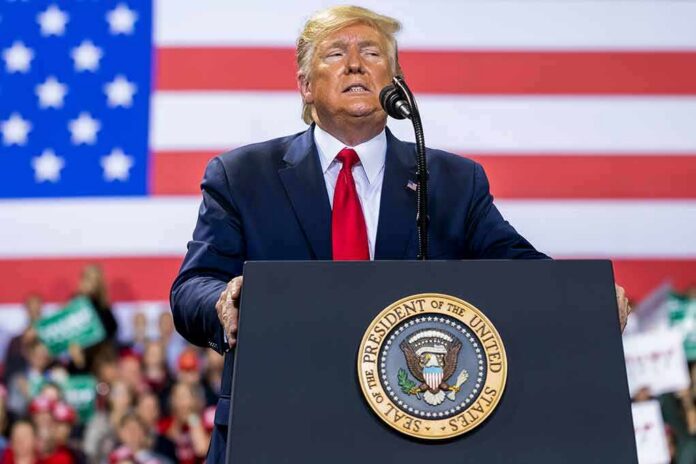
The presidency attracts both adulation and menace, and leaders often convert that peril into narrative power; President Trump’s line—“only consequential presidents get shot at”—sits squarely in that American tradition of interpreting violence against a head of state as proof of significance rather than as a grim, stochastic hazard.
The Short Version
- Trump has repeatedly framed attempts on his life as evidence of presidential consequence, delivering the line after high-profile security incidents.
- Historically, direct assaults on presidents and major candidates are rare but real; a minority of officeholders have faced them, with four assassinated while in office.
- Survivors and their allies often recast attacks as validation; coverage likewise tends to symbolize the violence, shaping perception of stature and vulnerability.
- The claim is rhetorical, not statistical: history shows danger clusters around prominence and accessibility, not moral worth or policy “impact.”
What Trump Said, and Why It Resonates
In multiple appearances following recent security scares, President Trump linked being targeted to presidential importance, remarking that “only consequential presidents get shot at.” He delivered versions of the line at a Flint, Michigan town hall and in broadcast interviews, explicitly tying the quip to his own experiences and to the pantheon of presidents who drew violent enemies. The construction is classic political storytelling: reframe risk as stature, then invite listeners to read danger as a proxy for impact. The phrasing stuck because it is simple, cinematic, and anchored to fresh events that made personal risk visible in real time.
Across American political culture, that move—converting threat into a claim of consequence—has durable roots. Leaders who survive attacks gain the opportunity to define the meaning of the event before others do. Trump’s version follows that script, turning vulnerability into a case for significance while signaling sangfroid: the danger is real, the president is undeterred, and the story’s moral is about the size of the presidency rather than the motives of the would-be assailant.
The Historical Baseline: How Often Presidents Are Targeted
Set the rhetoric aside, and the historical record is sobering and small. Four sitting presidents—Abraham Lincoln, James Garfield, William McKinley, and John F. Kennedy—were assassinated in office. Others were shot and survived, most famously Ronald Reagan in 1981. The Congressional Research Service (CRS) has cataloged roughly 15 direct assaults on presidents, presidents-elect, and major candidates across two centuries; about ten presidents—nearly a quarter of those who have served—have been the target of such attacks or attempts.
That tally does two things. First, it refutes any notion that presidential danger is a myth; it is not. Second, it warns against grand theories: the sample is tiny, the incidents are heterogeneous, and the causal mechanisms vary—from ideologically motivated conspiracies to delusional lone actors to security failures. The through-line is visibility and access. High-salience figures who travel, speak often, and draw crowds attract threats; that is an exposure argument, not an endorsement of a leader’s virtue or the scope of his policies.
Mechanism, Not Morality: Why Attacks Cluster Around Prominence
Assassination risk follows a few predictable vectors. Visibility increases target acquisition opportunities; retail politics multiplies contact points; and media amplification creates copycat incentives and magnifies the perceived “value” of an attack. Modern protection doctrines attempt to damper all three, but the presidency’s constitutional responsibilities—public appearances, coalition maintenance, crisis leadership—pull in the other direction. The result is managed, not eliminated, risk.
Research on media framing shows another feedback loop: coverage tends to cast presidents as uniquely vulnerable while reducing assailants to stock types—deranged loner, extremist foot soldier—which can both humanize the office and mythologize the encounter. That symbolic treatment conditions the public to conflate threat with significance; politicians sometimes lean into that logic because it is politically useful, especially after surviving an attack.
Rhetoric Versus Record: What “Consequential” Really Explains
Calling targeted presidents “consequential” is a flourish, not an explanatory model. It blurs two different claims: that consequential leaders attract enemies, and that being targeted demonstrates consequence. The first is sometimes true—transformational policy can galvanize violent opposition—but the second runs backward, treating the symptom (threat) as proof of the cause (impact). The record shows that attackers’ motives are inconsistent and often incoherent; what is consistent is the attacker’s focus on the most prominent, symbolically loaded figure available. Prominence is not the same as historical consequence, though the two often coincide in officeholders.
This is why the line works politically even though it fails as a social-scientific claim. It compresses a complex reality—risk distribution, security posture, media dynamics, the psychology of notoriety—into a memorable aphorism. Audiences map their own judgments onto “consequential”: supporters hear validation; critics hear self-aggrandizement. Both reactions are predictable in a polarized media ecosystem that rewards narrative clarity over causal nuance.
How We Got Here: The Long Arc of Protection and Meaning-Making
Protection of presidents professionalized after McKinley’s killing, with the Secret Service taking the lead in 1906; doctrine has evolved through technology, intelligence integration, and hardened venues. Yet every major attack or attempt resets expectations—Reagan’s shooting produced process and perimeter changes; the modern campaign trail now layers magnetometers, counter-surveillance, and aerial overwatch atop advance work. Even so, total risk elimination is a mirage; the presidency remains a public office in a free society, and exposure is part of the job’s democratic contract.
Meaning-making evolved in tandem. From Lincoln’s martyrdom to Kennedy’s televised funeral, the nation has metabolized violence against presidents as civic trauma and, at times, as myth. Survivors—Theodore Roosevelt’s 1912 campaign speech with a bullet in his chest; Reagan’s quips from a hospital bed—used humor and resolve to project control. Trump’s remark sits in that lineage of turning threat into a statement about stature, updated for a media era that clips, shares, and memefies such lines at scale.
What to Watch Going Forward
Three threads matter more than the quip itself. First, security practice: expect continuing tension between open political rituals and controlled environments. Second, narrative competition: presidents and their opponents will keep trying to define what violence “means,” because public interpretation shapes legitimacy and memory. Third, institutional resilience: the more politics treats threat as a badge of consequence, the more careful leaders and media alike must be not to feed the notoriety economy that can incentivize future attempts. History argues for sobriety, not spectacle, when lives and institutions are at stake.
Sources:
facebook.com, the-independent.com, npr.org, dailywire.com, en.wikipedia.org, washingtonexaminer.com, sodakgovs.com, theconversation.com, reuters.com, everycrsreport.com, theviolenceproject.org, congress.gov