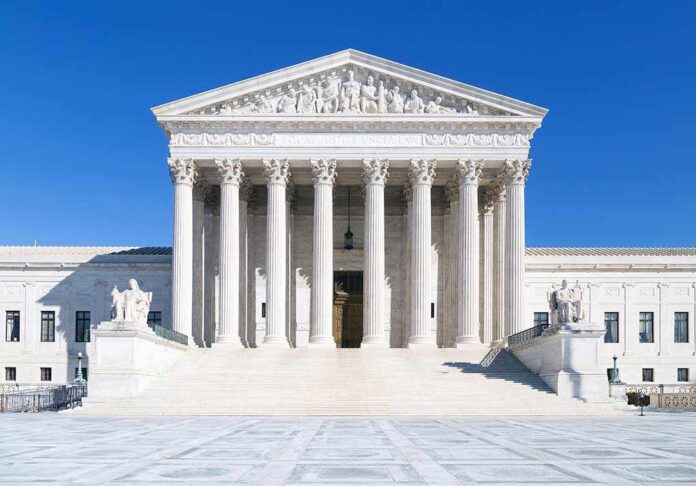
The Supreme Court put New Hampshire’s student ID voting fight on hold and told lower courts not to change rules right before Election Day.
Story Snapshot
- The Supreme Court paused a lower-court order that reopened student IDs as backup voter ID in New Hampshire.
- Justices relied on the Purcell principle, which warns against late election rule changes.
- The ruling is temporary and does not decide if the student ID limit is legal or needed.
- Student IDs had been accepted for years until a 2026 law removed them.
What The Supreme Court Actually Did
The Supreme Court issued an unsigned emergency order that reinstated New Hampshire’s bar on using student IDs to register or get a ballot for this election. The justices said the lower court had not justified changing rules so close to voting. They cited the Purcell principle, which urges courts to avoid last-minute shifts that can confuse voters and workers. Justice Ketanji Brown Jackson publicly dissented, arguing the lower court clarified information, not election rules.
The emergency ruling is temporary. It does not settle the core legal question about student IDs. The case can return after the election with a full record. For now, New Hampshire’s current list of accepted IDs stands, and student IDs are excluded. State officials and the Republican National Committee backed the request, and major outlets framed the outcome as a Republican win. The order focused on timing and process rather than a finding about fraud or ID security.
How New Hampshire’s Rules Changed In 2026
New Hampshire accepted student IDs for voter identification from 2012 until June 2026. A new law, known as HB 323, removed student IDs from the accepted list. Before this month’s Supreme Court step, a federal judge said student IDs could still be considered as part of “other evidence” when a voter lacked a listed ID. That ruling is now paused, so local officials cannot use student IDs even as backup this November.
The federal court record describes the old standards for student IDs. The card had to show the voter’s name, include a photo, and be issued or renewed within five years. Those rules matched the general identification requirements used for other documents. The new state law changed which documents count. It also narrowed how the “other evidence” safety valve can work in practice, at least for this election.
Why The Court Cited The Purcell Principle
The Purcell principle says courts should not change voting rules near an election because late changes can confuse voters and strain election workers. The Supreme Court has used this doctrine in many recent election disputes. The New Hampshire order fits that pattern. The justices emphasized stable rules, not whether student IDs are secure or risky. That leaves the facts about fraud, access, and document reliability for later review, after the election season ends.
Supporters of the state’s rule say fixed procedures protect trust and prevent last-minute chaos. Critics say the pause locks in a rule that may burden young voters and block a reasonable backup option. Because the Supreme Court did not decide the merits, both sides now plan for a longer fight. The legal questions include whether student IDs meet fair standards and whether the law treats similar documents the same way.
Who Is Affected And What Is Not Proven
College towns and first-time voters may feel this change most. Several reports say few voters rely only on a student ID, which may limit the direct impact. But the rule can still affect students who lack other paperwork on Election Day. Critics argue that there is no verified record showing student IDs caused fraud in New Hampshire. The Supreme Court’s order did not cite any such evidence; it focused on timing and stability.
For voters, the bottom line is simple. If you are voting in New Hampshire, do not bring only a student ID. Bring an accepted form of identification listed by the state. For citizens watching the bigger picture, this case shows how emergency rulings can shape elections without fully settling the law. Many Americans across the spectrum see this as more evidence that process fights often overshadow real solutions and clear guidance for voters.
Sources:
courthousenews.com, news.bloomberglaw.com, wjla.com, usatoday.com, thehill.com, nhpr.org, indepthnh.org, wmur.com, thedartmouth.com