Israel’s precision strikes on Hezbollah targets in Beirut’s southern suburbs defy ceasefire expectations and spotlight the real red line: stopping Iran-backed terror from threatening America’s closest ally.
Story Highlights
- Israeli warplanes hit Hezbollah-linked sites in Beirut’s Dahiyeh after evacuation warnings, citing an immediate security threat [1][2][3].
- Israel tied the operation to high-value Hezbollah targets, including a commander claim connected to the elite Radwan force [3][6].
- Military statements framed the action as part of a broader push to expand control against Hezbollah infiltration routes in southern Lebanon [1][2].
- Competing narratives emerged quickly as strikes occurred in dense urban areas long used by Hezbollah for command infrastructure [2][3][4].
Israeli Strikes Target Hezbollah Strongholds In Beirut’s Dahiyeh
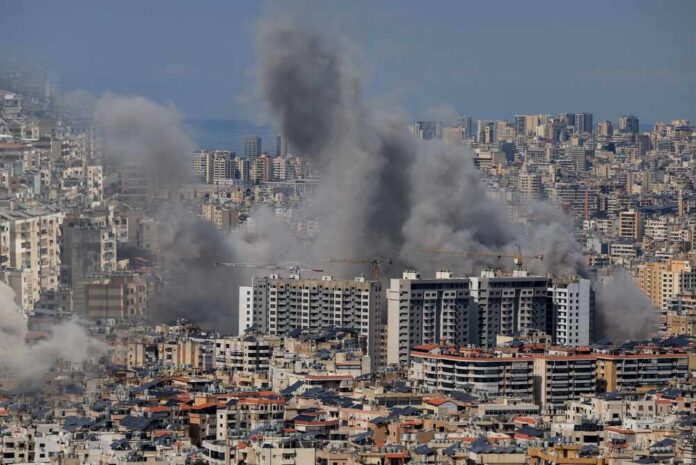
Israeli forces carried out airstrikes in Beirut’s southern suburbs known as Dahiyeh, an area repeatedly identified as a Hezbollah stronghold. Media reports indicated Israel issued evacuation warnings ahead of the operation, then struck targets the military linked to Hezbollah’s command and weapons infrastructure [1][2][3]. Public briefings described specific targets, including underground facilities and drone-linked sites, consistent with past Hezbollah use of urban cover to conceal military assets. The strikes followed days of escalating cross-border fire and renewed threats toward northern Israel [1][3][4].
Israeli commanders publicly connected the operation to a larger campaign to degrade Hezbollah’s ability to infiltrate or launch mass-casualty attacks. Statements referenced moves to “expand the area” of control against Hezbollah positions across southern Lebanon, reinforcing that the Beirut action was not an isolated sortie but tied to broader operational goals of deterrence and denial [1][2][5]. That framing underscores a strategic message to Tehran’s network: command nodes and elite units are not immune from reach, even inside dense urban zones used for political and propaganda cover [3][5].
Claims Of High-Value Targets And The Radwan Connection
Reports from the region said Israel targeted senior figures and infrastructure connected to Hezbollah’s elite Radwan force, which Israel has long accused of planning cross-border assaults. Separate coverage cited Israeli claims of killing a Hezbollah commander in Beirut, identifying him as Ahmed Ali Balout linked to Radwan operations [6]. While independent verification can lag during active strikes, these claims track with a consistent Israeli objective: disrupt leadership, degrade specialized assault units, and reestablish deterrence following repeated Hezbollah rocket and drone incidents [3][6].
Hezbollah’s practice of embedding assets within civilian districts perpetually complicates verification and casualty reporting, especially in the first hours after strikes. News footage and reports from Beirut highlighted evacuations, smoke plumes, and area damage after precision munitions hit selected structures in Dahiyeh [2][4]. The information environment in such urban conflicts is asymmetrical: militaries control initial operational details while local authorities and residents shape early damage accounts, leaving the truth claims to be sorted as independent access expands [4][5].
Ceasefire Friction, Escalation Concerns, And U.S. Strategic Stakes
Coverage framed these strikes as occurring days after a United States–supported ceasefire push, prompting questions about escalation and timing. Israel’s position linked the actions to immediate threats and ongoing Hezbollah attacks, arguing deterrence cannot pause for paper deals that terrorists exploit [1][5]. Reports described intensified Israeli activity in southern Lebanon and around Beirut, reflecting an operation calibrated to deny command-and-control sanctuaries and to blunt Rocket, Unmanned Aerial System, and infiltration threats directed at Israeli civilians [1][2][3].
Earlier today,
Israel launched airstrikes on southern suburb of Beirut at orders of Netanyahu
Iran has threatened to retaliate with attacks on Israel, implying that it could lead to “Operation True Promise 5” pic.twitter.com/d92IWaaDlK
— Brian’s Breaking News and Intel (@intelFromBrian) June 7, 2026
For American readers, the stakes are clear. Hezbollah serves as a forward arm of Iran’s regional project, and its arsenal targets the Middle East’s only liberal democracy allied closely with the United States. Past experience shows that allowing armed groups to hide in cities invites more civilian suffering and emboldens extremists. Deterrence backed by precision targeting and civilian evacuation warnings, as reported from Beirut, signals a rules-based approach against unlawful militant entrenchment, not a campaign of collective punishment [1][2][3][4].
What Conservatives Should Watch Next
First, monitor verifiable confirmation of the high-value target claims connected to the Radwan force leadership, as those outcomes shape Hezbollah’s calculus and Iran’s messaging [3][6]. Second, watch whether Hezbollah scales attacks to test Israel’s red lines or Iran moves to widen the front through proxies. Third, track whether ceasefire diplomacy accounts for the reality on the ground—terror networks exploiting pauses to rearm—versus pressuring Israel to absorb more risk. Policy built on facts, not slogans, keeps civilians safer and punishes terror, not families [1][4][5][6].
Sources:
[1] Web – Israel Strikes Beirut’s Southern Suburbs Days After US-Supported …
[2] YouTube – Israeli army announces start of airstrikes on southern Beirut suburb
[3] YouTube – Residents flee Beirut’s southern suburbs after Israel orders strikes
[4] YouTube – Israeli air strikes hit Beirut: Lebanon’s southern suburb of Dahieh …
[5] YouTube – Israeli strikes hit Beirut’s southern suburbs amid new evacuation …
[6] YouTube – Israel launches new strikes on Beirut: Military says it is …