As leaders argue over deportations and border fences, Pope Leo XIV is quietly flying into Europe’s most overwhelmed migrant outpost to talk about human dignity instead of party politics.
Story Snapshot
- Pope Leo XIV will end his Spain trip in the Canary Islands, one of Europe’s most pressured migrant entry points, to highlight the human cost of Atlantic migration.
- Local bishops say they feel “powerless” amid surging arrivals and deaths at sea, and hope the visit refocuses attention on humane treatment of migrants.
- The itinerary—migrant docks, testimonies, and a university migration symposium—signals a push for solidarity and practical solutions, not slogans.
- The visit exposes a deeper divide between ordinary citizens demanding order and compassion, and political elites turning migration into a perpetual campaign issue.
Why the Canary Islands Matter in the Migration Fight
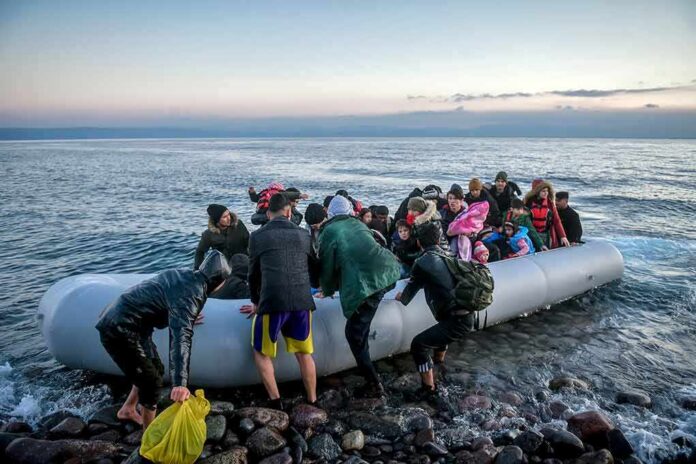
Spanish and Vatican sources describe the Canary Islands as a frontline gateway into Europe, where boats from Africa arrive after dangerous Atlantic crossings, often with dead or missing passengers.[1] Local bishops say the islands have become an “epicenter” of the Atlantic migration crisis and admit they “feel powerless” as numbers rise and resources are strained.[1][2] That language captures what many Americans feel about Washington: big promises, little control, and a system that never seems to fix what is clearly broken.
Pope Leo XIV’s upcoming journey to Spain runs from June 6–12, with the Canary Islands as the final and most symbolically charged stop. Reports indicate he will travel to Gran Canaria and Tenerife, visiting the Arguineguín dock that has processed thousands of rescued migrants, as well as church and civic sites.[2] By ending his trip at the periphery rather than in a palace, he is deliberately placing those on the margins—homeless, prisoners, and migrants—at the center of the Church’s public witness.[1]
The Pope’s Message: People Before Political Theater
Vatican and Catholic outlets say the core goal of the visit is to “put a human face” on migrants and emphasize dignity, solidarity, and reconciliation over partisan point scoring.[1] The schedule backs that up: in the islands he will meet migrants directly, hear testimonies from Africa and Latin America, and pray at the very dock where overcrowded boats are brought in.[3] This is not a policy blueprint; it is a moral intervention that challenges both hardline crackdowns and cynical open-border rhetoric that never funds real integration.
Church leaders stress that the visit is pastoral, not a campaign stop for any party, and that they are not writing Spain’s immigration laws.[1][2] Yet everyone understands this will land in the middle of fierce European debates over deportations, detention, and border fences. That tension will sound familiar to Americans: when religious leaders speak about life, war, poverty, or migration, one side accuses them of “meddling in politics” while the other selectively quotes them for partisan gain. In both cases, the deeper issues of competence, corruption, and accountability often go untouched.
Beyond Left vs. Right: A System That Fails Migrants and Locals
Reporting ahead of the trip notes that Catholics in Spain hope the pope can calm political polarization around migration while still naming the suffering in places like Arguineguín. Residents see overwhelmed services, strained budgets, and rising tensions; migrants see desperation, exploitation by smugglers, and too many funerals.[1] When states respond mainly with slogans—whether “welcome all” or “deport all”—both local communities and migrants bear the cost, while distant elites trade talking points on television.
Cardinal Ambo David said the decision to include the Canary Islands in his itinerary shows the visit is "not merely a ceremonial visit.""The Pope is going to where the pain is," he said, referring to one of Europe's main entry points for migrants crossing from Africa. @bworldph
— Arjay@BWorld 🇵🇭 (@Arjay_BWorld) June 5, 2026
The Canary Islands visit will also coincide with an international migration symposium hosted by Villanova University, bringing researchers, church leaders, and policymakers together on the islands.[4] That pairing—symbolic gestures at the docks, policy conversation in the conference hall—signals a recognition that compassion without order is chaos, but order without compassion becomes cruelty. Many Americans across the spectrum would recognize the pattern: big conferences, big rhetoric, but little follow-through once cameras leave and lobbyists take over.[4]
What This Says About Power, Borders, and Ordinary People
Pope Leo XIV’s broader Spain itinerary underlines his theme of moving from “institutions to the peripheries,” from royal palaces to homeless shelters, prisons, and migrant ports. He will meet Spain’s political leadership in Madrid, inaugurate the Tower of Jesus Christ at the Sagrada Familia in Barcelona, then fly to the islands that his predecessor wanted to visit to highlight the migration crisis.[2] That arc quietly contrasts polished centers of power with the rough edges where policies actually land on real lives.
For conservatives, the Canary Islands story underscores legitimate worries that uncontrolled migration strains social services, drives crime fears, and is often managed by unaccountable international bureaucracies.[1] For liberals, it highlights the deadly consequences of treating desperate families as statistics instead of people, and the need to confront root causes like wars and economic collapse.[2] For both, it exposes how political and financial elites can keep the system just broken enough to campaign on, while coastal communities and migrants are left to absorb the shock.
Sources:
[1] YouTube – Pope Leo to visit Canary Islands to underscore support for migrants
[2] Web – Canary Islands bishops on migration: ‘We feel powerless’
[3] Web – Pope Leo expected to travel to migrant hotspot in Spain, cardinal says
[4] Web – ‘Now I wait for Pope Leo,’ says the Canary Islands migrant who …