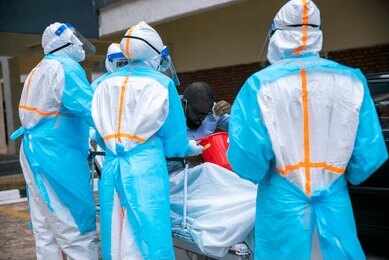
Over 400 people have died in Central Africa’s spreading Ebola outbreak, and the numbers still point to a crisis that is far worse at home than it looks abroad.
Quick Take
- The outbreak has moved across the border from the Democratic Republic of the Congo into Uganda.
- The World Health Organization declared the outbreak a Public Health Emergency of International Concern.
- The Centers for Disease Control and Prevention says the risk to the American public remains low.
- Officials say the Bundibugyo strain has no approved vaccine or specific treatment.
Cases Keep Rising in the DRC
The World Health Organization and the Centers for Disease Control and Prevention both describe the outbreak as centered in remote areas of eastern Democratic Republic of the Congo and Uganda. The Centers for Disease Control and Prevention says the outbreak spread into two more provinces in the Democratic Republic of the Congo, while Uganda has reported cases tied to travel from the neighboring country.
That spread matters because Ebola does not need a large number of cases to cause major disruption. The virus spreads through direct contact with bodily fluids, and the World Health Organization says Ebola is severe and often fatal. It also says the average case fatality rate is around 50 percent, though it can vary widely by outbreak.
Why Health Officials Sound Alarmed
Health officials are worried for a simple reason: this strain is hard to stop. The World Health Organization says Bundibugyo virus disease has no approved vaccine or specific antiviral treatment, which leaves responders with contact tracing, isolation, and supportive care as the main tools. That makes fast detection even more important in places where security problems and weak roads slow down access.
The World Health Organization also says the outbreak was serious enough to meet the legal standard for a Public Health Emergency of International Concern. In its declaration, the agency cited the risk of further spread across borders. That judgment does not mean the disease is already global. It does mean the outbreak has crossed a threshold that demands wider international attention and resources.
Why the Global Risk Still Looks Low
The Centers for Disease Control and Prevention says no Ebola cases tied to this outbreak have been confirmed in the United States. It also says the risk to the American public and travelers remains low, and that the chance of spread to the United States is considered very low. The agency reached that view even while warning that any imported case would still require a fast public health response.
🩺 Ebola Outbreak Update — DRC & Uganda
1,333 confirmed cases in DRC as of 30 June, up from 1,274. Total: 1,354 confirmed, 362 deaths.
Sud-Kivu confirmed as the 4th affected DRC province.https://t.co/nDiX2cWkAm
— thechinadoc (@thechinadoc) July 2, 2026
That split between local danger and wider risk is the key story. The outbreak is severe where it is happening, and the death toll shows that clearly. But the official United States risk assessment is built on the current pattern of transmission, which has stayed tied to known outbreak areas and imported cases so far. If surveillance misses hidden spread, that picture could change quickly.
What Comes Next
The next test is whether responders can find every chain of transmission before the virus finds new ones. The World Health Organization says contact tracing, surveillance, and community engagement are essential. Those tools work best when health teams can move freely and when people trust them enough to report illness early. In conflict zones, that is often the hardest part of the job.
For now, the outbreak has exposed a familiar gap in global health: the places most at risk are often the hardest to reach, while the rest of the world waits to see whether the danger stays contained. That gap fuels frustration on all sides, because it leaves ordinary people dependent on institutions that often seem slow, distant, and divided when speed matters most.
Sources:
insiderpaper.com, state.gov, nature.com, canada.ca, cdc.gov, oxfam.org