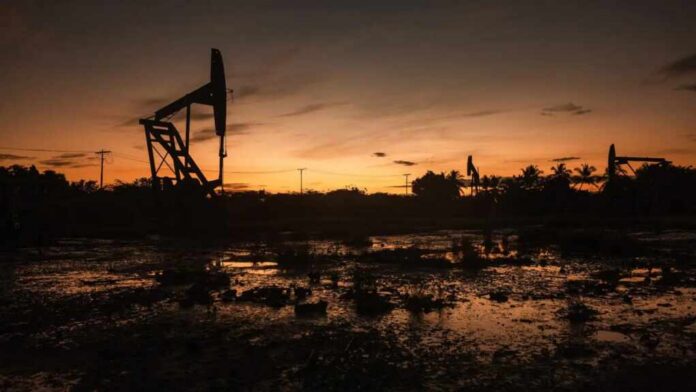
Iran’s de facto chokehold on the Strait of Hormuz is colliding with Trump-era maximum-pressure sanctions—setting up an energy shock that could hit American families right in the wallet even as Tehran’s oil machine buckles.
Story Snapshot
- Iranian crude exports have fallen below 1.4 million barrels per day in early 2026, down sharply from normal capacity levels near 3.3 million.
- U.S. sanctions expanded in February to target Iran’s “shadow fleet,” aiming at vessels, brokers, and shell networks used to move oil outside the formal system.
- Regional escalation following late-February strikes and retaliation has contributed to a de facto Strait of Hormuz closure—threatening a major global oil chokepoint.
- Analysts warn extended disruption could lift Brent crude toward late-2026 highs in scenario forecasts, while the IEA has moved to emergency reserve releases.
Maximum Pressure Meets a Global Chokepoint
President Trump’s 2026 posture toward Iran has combined economic pressure with sharper deterrence messaging, including a 25% tariff threat against countries still doing business with Tehran. That approach lands on a basic reality: the Strait of Hormuz is not a political talking point, but a physical bottleneck. Roughly 20 million barrels per day transited the strait in 2024, making any sustained disruption a global event, not a regional one.
Energy markets respond to risk faster than bureaucracies do. The research indicates that the strait is under a “de facto” closure as of March 2026 amid retaliatory activity across multiple Gulf-region countries. Even without a formal blockade declaration, higher insurance costs, rerouting, and security delays can reduce effective supply. For U.S. consumers, that typically translates into upward pressure on fuel, freight, and the everyday cost of goods.
Sanctions Target Iran’s Shadow Fleet and Payment Channels
February’s sanctions expansion focused on the logistics that make sanctions evasion possible: ships, intermediaries, and legal entities tied to the “grey” export system. The research cites more than 30 designated individuals and entities and identifies specific vessels linked to alleged shipments, including HOOT and OCEAN KOI. Treasury messaging framed these actions as restricting revenue connected to weapons programs and proxy support—an argument centered on cutting off cash, not symbolism.
Sanctions pressure is also hitting the financial plumbing that keeps trade moving. International banks are described as tightening screening and refusing transactions with even minor Iranian “traces,” reflecting fear of secondary sanctions exposure. That kind of over-compliance can be disruptive well beyond Iran, because it deters legitimate counterparties from taking any compliance risk at all. From a limited-government perspective, this is the tradeoff policymakers accept when sanctions become a primary tool: enforcement power expands, and global firms react defensively.
Iran’s Oil Output Falls, but the Price Risk Stays
The research describes Iran’s oil industry as “functionally defeated,” with exports below 1.4 million barrels per day in Q1 2026 and an estimated export capacity reduction of roughly 60% from normal levels. Iran is typically cited near 3.3 million barrels per day, making the decline material. Yet lower Iranian volumes do not automatically mean lower prices; they can mean less cushion when shipping lanes or regional facilities become unstable.
Forecasts in the research illustrate how quickly the outlook flips. BloombergNEF estimates that a complete removal of Iranian exports would raise Brent crude averages to about $71 per barrel in Q2 2026 and potentially $91 in Q4 2026 if disruption persists. Analysts also warn $100 oil is plausible in prolonged scenarios. Those are not guarantees, but they provide a structured way to think about what’s driving prices: the risk premium from uncertainty and interruption.
Strategic Side Effects: Russia’s Windfall and Allied Friction
One uncomfortable consequence highlighted in the research is Russia’s potential “windfall” from higher prices and reduced competition, even as Western governments debate how to handle energy shortages. Washington’s temporary exemption allowing India to purchase certain Russian oil is presented as a crisis-mitigation step—an acknowledgment that energy security can force imperfect choices. G7 resistance, with France noted as pushing back against easing pressure on Russia, shows how quickly alliances strain when costs rise.
The bigger point for Americans is that foreign oil shocks tend to amplify domestic frustrations—especially after years when voters were told energy scarcity was a virtue. The research does not quantify U.S. pump prices, but the mechanism is straightforward: disruption at a chokepoint moves global crude benchmarks, and global benchmarks filter into refined products. Stable supply, credible deterrence, and disciplined spending matter more when markets are fragile.
Sources:
Oil can hit $91 a barrel in late 2026 on Iran disruption
Global Oil Market Implications of U.S.-Israel Attack on Iran
Sanctions to Combat Illicit Traders of Iranian Oil and the Shadow Fleet
Enforce sanctions to prevent Russia from benefitting in a prolonged Iran crisis