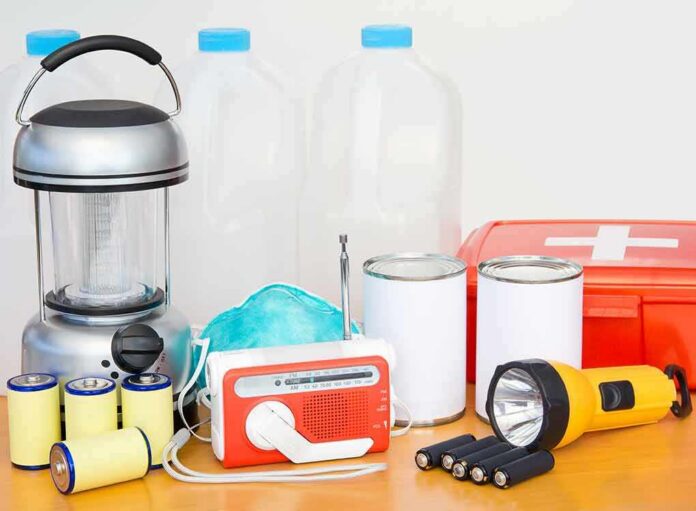
Governments on both sides of the Atlantic are telling households to hold at least three days of basic supplies, signaling a push for self-reliance if services fail.
Story Snapshot
- The European Commission backs 72-hour self-sufficiency and plans public guidelines.
- United States guidance urges a three-day kit with food, water, cash, and medicines.
- United Kingdom checklists spell out items and amounts for a three-day window.
- Officials say 72 hours covers the first stretch while services come back online.
What Officials Are Asking Households To Do
European Union leaders endorsed a plan that asks the public to maintain basic supplies for at least seventy-two hours. The European Preparedness Union Strategy says the bloc will propose guidelines to help families meet that target and store essentials for short disruptions. United States guidance from Ready.gov tells people to build a kit for at least three days with food, water, cash, and needed medicines. United Kingdom officials provide a specific household checklist for the same period.
United Kingdom materials recommend three days of bottled water at three litres per person per day for drinking, plus nonperishable food, a torch, a radio, a charged power bank, first-aid items, and essential medication. United States materials specify at least one gallon of water per person per day, nonperishable food, a flashlight, batteries or power, a radio, and key documents. United States responder toolkits repeat the one-gallon rule and call for food that needs little or no cooking over three days.
Why Seventy-Two Hours Matters
European Parliament material explains that the first seventy-two hours after a shock are often the hardest period. During that time, emergency crews work to restore services and reach people, but access can be limited by outages or blocked roads. The guidance aims to bridge that gap so families can handle basic needs until help arrives or utilities restart. This “all-hazards” approach applies to storms, blackouts, cyber incidents, or supply disruptions, not only to war or terror threats.
Authorities also stress that three days is a floor, not a ceiling, and that needs can vary by health, climate, and household size. The lists focus on common items almost every family can store. That includes shelf-stable food, safe water, needed prescriptions, backup power for phones, and a simple radio for updates. The goal is practical resilience, not panic buying. Officials do not claim a specific imminent event is driving the advice in these documents.
Gaps Between Guidance And Reality
Public readiness lags behind the checklists. A United Kingdom survey in 2026 found that sixty percent of people said they had roughly three days of nonperishable food. Only thirty-seven percent said they had three days of bottled water. Those numbers show many homes would still be short on basics if taps stopped or stores closed for a few days. United States responder materials seek to close that gap with clear, itemized steps families can act on now.
Seriously, what is going on right now? 🚨
Here’s a quick rundown of all the worrying stuff happening lately… 👇
Countries telling people to get prepared:
• Japan 🇯🇵: Wants everyone to have at least 3 days to a week of food, water, and emergency gear by November 2.
• UK 🇬🇧:…— Genuine Crypto (@GenuineCryptoo) October 30, 2026
Differences in the numbers can confuse people. United States guidance uses one gallon of water per person per day. United Kingdom guidance uses three litres per day for drinking and notes extra water is needed for cooking and washing. The aims are the same, but the measures are not identical. That makes it important to follow the plan where you live and adjust for health needs, infants, older adults, and pets.
What This Means For Families And Communities
Households that meet the three-day mark can ride out short outages with less stress and fewer 911 calls, leaving first responders free to reach the most at-risk. This is not about politics. It is about water, food, medicines, and power during the first days of a crisis. In a time when many doubt that large systems will protect regular people, these steps put a small but real buffer in your own hands.
Sources:
lifesitenews.com, beready.campaign.gov.uk, civil-protection-humanitarian-aid.ec.europa.eu, ready.gov, gov.uk, europarl.europa.eu