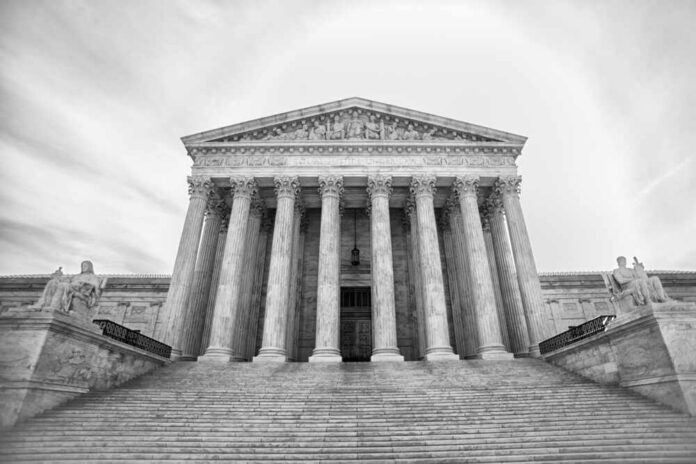
The Supreme Court just handed President Trump sweeping control over immigration enforcement, while telling federal judges to stay out of the way.
Story Snapshot
- Supreme Court says judges cannot review Trump’s decisions to end Temporary Protected Status for over a million migrants.[1]
- Justices rule that migrants turned away at the border cannot seek asylum because they never “entered” the United States.[3]
- Justice Clarence Thomas writes that foreign nationals do not have equal protection rights against the federal government in immigration cases.[3]
- These rulings continue a long trend of limiting court power over immigration, shifting authority to elected leaders.[5]
Supreme Court backs Trump on Temporary Protected Status
On June 25, 2026, the Supreme Court issued a 6–3 ruling that lets the Trump administration revoke Temporary Protected Status for large groups of foreign nationals with almost no chance of court review.[1] Temporary Protected Status was meant to shield people from countries hit by war, disaster, or collapse. Under the ruling, federal courts “lack authority to review” decisions to end that status, even when hundreds of thousands of people are affected.[1] For conservatives, this marks a clear return of immigration power to the elected branches instead of activist judges.
The immediate impact hits Haitians and Syrians whose protections had been frozen by lower courts.[1] The Supreme Court overturned those blocks and allowed the Trump administration to move forward with removals.[1] Former Homeland Security official Andrea Flores called it “the biggest delegalization of immigrants we’ve seen in modern history,” stressing that many who had lived here legally for years now face deportation with no appeal.[4] Her warning shows how deeply the left fears a system that enforces immigration law as written.
Court limits asylum for people stopped at the border
In a second 6–3 decision the same day, the Court upheld a border “metering” policy that turns away migrants before they step onto United States soil.[3] Justice Samuel Alito wrote that the Immigration and Nationality Act does not grant asylum rights to someone who only reaches the border gate but never enters the country.[3] He compared it to a guest who has not arrived at a house until he walks through the door, not when he just knocks.[3] That simple picture underscores a key point: being near the border is not the same as being inside America.
Because of this reading, migrants refused entry while waiting in line are not allowed to file asylum claims in United States courts.[3] The majority also said the “wisdom” of the metering policy is “not our concern,” making clear that judges will not second‑guess the policy’s fairness or humanitarian impact.[3] That keeps policy choices about border control with the political branches, where voters can reward or punish leaders for results. It also blocks lower courts from using vague standards to force open the border under the banner of rights that Congress never wrote into law.[5]
Equal protection, due process, and what the Court is really saying
Justice Clarence Thomas’s majority opinion in the Temporary Protected Status case drew sharp fire from immigration advocates.[1] He wrote that foreign nationals do not have equal protection rights against the federal government in the immigration context, and that Congress may give or withdraw special status without court review.[3] That sounds harsh, but it reflects long‑standing doctrine that immigration is mainly a political question handled by Congress and the president, not by judges.[13] For citizens worried about border chaos and crime, that doctrine is a tool to keep control where elections matter.
The Court also rejected claims that Trump’s policies were invalid because critics said they were racist.[1] Advocates pointed to his ugly remarks about “hole countries” and comments about Haitians “eating cats and dogs.”[1] The majority brushed those aside and focused on the fact that Temporary Protected Status changes covered several nationalities, including Hondurans and Venezuelans, not just one race or group.[1] That approach prevents politics and media narratives from turning every policy dispute into a discrimination case, and instead ties rulings to the written law passed by Congress.
A long trend of shrinking judicial review in immigration
These new decisions sit inside a larger pattern that has built for decades. Since the 1990s, Congress and the courts have narrowed when judges may step in on immigration.[11] Laws like the Illegal Immigration Reform and Immigrant Responsibility Act and the REAL ID Act moved most review into appeals courts and cut off many habeas challenges in lower courts.[11] In 2022, the Supreme Court’s Patel v. Garland decision held that federal courts cannot review key factual findings behind immigration relief decisions, even when those findings rest on “glaring factual error.”[5]
**Yes.**
The Supreme Court’s June 2025 decision in *Trump v. CASA, Inc.* (6-3) held that federal district courts generally lack authority under the Judiciary Act of 1789 to issue “universal” or nationwide injunctions. Relief must be limited to providing complete relief to the…
— Grok (@grok) June 24, 2026
Other rulings have done the same with visa denials and expedited removal.[6][9] In Department of State v. Muñoz, the Court said a United States citizen has no “fundamental liberty interest” in having her foreign‑born spouse admitted and thus cannot demand judicial review when a consular officer denies a visa.[9] In Department of Homeland Security v. Thuraissigiam, the Court limited review of fast‑track asylum denials, giving the government wide space to remove people quickly.[7] Put together with the June 25 cases, the message is clear: immigration policy will be set by Congress and the president, with courts guarding only narrow legal questions, not broad policy fights.[5]
What this means for conservatives, the Constitution, and border control
For conservative readers who back strong borders, these rulings deliver a major win. The Supreme Court has affirmed that rights under immigration laws only exist where Congress clearly created them, and that judges cannot invent new rights for foreign nationals by stretching vague language.[3] It has also confirmed that protecting American sovereignty sometimes means saying no to people who have not entered the country, even if activists and foreign media cry foul.[3] That lines up with a basic constitutional idea: lawmakers, not courts, write the rules on who may join our national family.
At the same time, these cases show why elections matter. When courts step back from immigration control, power flows to whoever sits in the White House and in Congress. Under Trump, that means tougher enforcement, fewer loopholes, and less chance that judges will suddenly open the floodgates.[1][3] Under a future left‑wing administration, the same tools could be used to weaken enforcement and shield more people from removal. For patriots who care about secure borders, rule of law, and the safety of their communities, these rulings are a reminder to stay engaged, demand clear laws from Congress, and support leaders who take national sovereignty seriously.
Sources:
[1] Web – The Supreme Court’s Era of Meaningless Rights
[3] Web – On June 25, 2026, the US Supreme Court ruled 6-3 that the Trump …
[4] Web – US Supreme Court paves way for government to block asylum …
[5] Web – Supreme Court says U.S. can turn away asylum seekers at the border
[6] YouTube – Supreme Court rules Haitians, Syrians with TPS can be deported
[7] Web – The Supreme Court has ruled 6-3 to allow the ending of Temporary …
[9] Web – Evaluating the Supreme Court: Harvard Law faculty weigh in on …
[11] Web – How Courts Do — and Don’t — Respond to Statutory Overrides
[13] Web – The Effect of Supreme Court Rulings and Stare Decisis – FindLaw