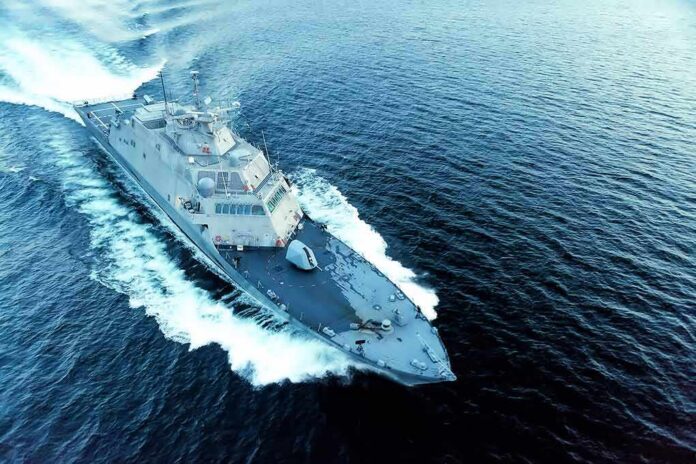
The Navy just put $25 million behind shipboard artificial intelligence that promises to spot collision risks before sailors do.
Story Snapshot
- The Navy awarded Applied Intuition a $25 million production contract for shipboard sensor fusion.
- Initial installs will go on five Arleigh Burke-class destroyers, with automated collision alerts.
- The system fuses camera and infrared feeds into one picture for crews.
- The design supports data uploads from sea and software updates back to ships.
Navy Moves From Pilot To Production On Shipboard AI
Breaking Defense reported that the United States Navy awarded Applied Intuition a $25 million contract to deploy an artificial intelligence sensor fusion system, starting with five Arleigh Burke-class destroyers. The reported capability will merge inputs from cameras and infrared sensors into one display. The goal is to give sailors a clearer view in busy waters. The announcement marks a shift from testing toward production. Inside Defense described the effort as a fleetwide perception layer over time.
Applied Intuition’s product builds on an earlier pilot called the Data Edge Collection Kit, which the Navy tested earlier this year, according to the coverage. The new Integrated Perception System is framed as an “infrastructure layer.” That means it sits between ship sensors and crew displays to collect data, train perception models, and push updates. This design aims to speed improvements while ships stay on mission. It also reflects how the Navy is trying to modernize older systems.
What The System Promises To Do At Sea
The Integrated Perception System is reported to pull video and infrared feeds from sensors that were not built to work together, then create a single picture for the bridge team. The system will issue automated alerts when another vessel appears on a collision course. That function targets a top safety risk in crowded sea lanes and tight straits. By fusing views, the display could cut clutter and help crews judge distance and speed in bad weather or at night.
The architecture is meant to support a “continuous learning loop,” where ships capture operational data and send it ashore when bandwidth is available and conditions are secure. Engineers can then refine models and return software updates over the air, rather than wait for port calls. This update pipeline mirrors how phones and cars get new features. At sea, it could shorten the time from a lesson on one ship to a fix for the wider fleet.
Why This Contract Matters Now
The Government Accountability Office has said the Department of Defense struggles to move artificial intelligence from labs to daily use, due to long acquisition timelines, data gaps, and integration issues. A funded production install on five destroyers shows a concrete path to get tools in front of sailors. It also tests whether ship crews will trust fused displays and alerts during real missions. That step is crucial for broader adoption and future budgets.
Defense policy now expects formal test and evaluation for artificial intelligence systems, including work by operational test agencies before full fielding. This contract’s approach—pilot to production with data collection and updates—fits that push. The scale is still small, and not every document is public, but the move signals that the Navy sees enough value to start installing. If results hold, leaders could expand installs across more surface ships.
What We Still Do Not Know From Public Reports
Media reports describe the functions and the five-ship plan, but they do not provide measured accuracy, false alert rates, or human factors results yet. The articles also do not include the award notice or a detailed statement of work. That is common when programs touch operations and security. As installs begin, the most useful next figures would show how fast crews spot hazards, how often alerts are right, and how updates improve performance.
🔴 Navy awards Applied Intuition $25M for AI sensor fusion on warships
Applied Intuition won a $25 million contract to deploy its Intelligent Perception System (IPS) on five Arleigh Burke-class destroyers, with potential fleet-wide expansion. IPS synthesizes data from cameras… pic.twitter.com/FjhL68RRGA
— NewsTongue (@NewsTongueX) October 22, 2026
For sailors, the near-term impact is practical: a simpler display and faster warning in tight waters. For taxpayers, the key test is whether this $25 million seed delivers safer operations without costly retrofits. For leaders, the question is scale. If the system reduces risk and fits within current networks, it will be easier to justify more installs. If not, the Navy will need to adjust models, training, or where and when the fusion layer runs.
Sources:
breakingdefense.com, nampa.org