New York City’s new “racial equity” roadmap ties a $180,000+ wealth-gap statistic to higher taxes and a plan to shrink the NYPD—an approach that could redefine public safety and affordability in America’s biggest city.
Quick Take
- Mayor Zohran Mamdani released a 375-page “Preliminary Racial Equity Plan” citing a wealth gap of more than $180,000 between White and Black households in NYC.
- The plan supports expanding DEI-focused governance while backing major revenue hikes on high earners and corporations to fund a $127 billion agenda.
- Mamdani’s broader platform includes free buses, city-owned grocery stores, rent freezes, and a $30/hour minimum wage within four years.
- The plan also contemplates cutting roughly 5,000 NYPD officer positions, raising immediate questions about crime deterrence and response capacity.
- Several major pieces—especially tax changes—depend on state approval, where Gov. Kathy Hochul has opposed tax increases.
What Mamdani’s Plan Says—and Why the Wealth Gap Is Central
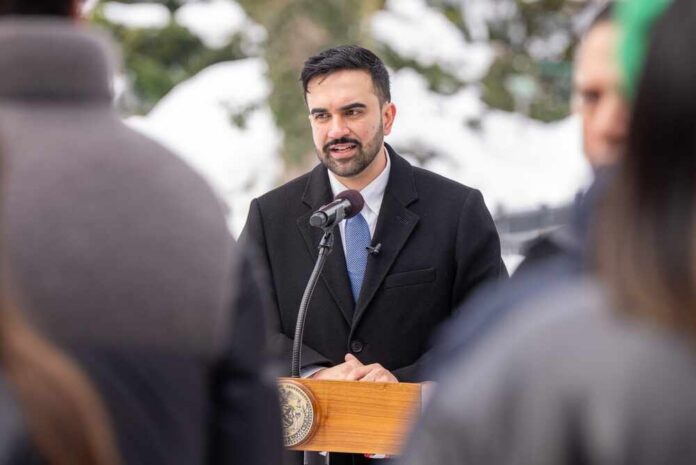
New York City Mayor Zohran Mamdani’s administration released a 375-page “Preliminary Racial Equity Plan” built around a headline figure: a racial wealth gap exceeding $180,000. The document cites median wealth above $200,000 for White households and under $20,000 for Black households, framing the disparity as the product of long-running systemic forces. Mamdani has argued the plan targets “policies and politics,” not individual New Yorkers, while opening a 30-day public comment period.
The plan’s structure matters as much as its rhetoric. City agencies would be required to evaluate their work through a racial equity lens across multiple policy areas, including the economy, housing, public safety, health, and infrastructure. That kind of mandate expands the role of government from delivering services to measuring outcomes by demographic categories—an approach that has fueled national pushback in the Trump era, where federal agencies have moved to roll back race-based initiatives.
Taxes, Spending, and the State-Level Roadblock
Mamdani’s equity framework is paired with a price tag: a broader $127 billion agenda. His campaign-linked proposals include free buses, city-owned grocery stores, rent freezes, and a minimum wage increase to $30 per hour within four years. Funding mechanisms described in coverage include raising the corporate tax rate to match New Jersey’s 11.5% and adding a 2% flat tax on the top 1% of earners making more than $1 million annually—moves projected to generate billions in revenue.
Albany is the immediate choke point. New York State must approve key tax changes, and Gov. Kathy Hochul has opposed tax hikes, complicating the mayor’s strategy. That dynamic sets up a familiar friction in blue-state governance: city leaders campaign on big, sweeping fiscal promises, but state-level officials worry about competitiveness, outmigration, and volatility in revenue tied to high earners and large employers. For households already squeezed by cost of living, the unresolved question is whether new spending can measurably improve affordability without triggering new budget stress.
NYPD Cuts and the Public-Safety Tradeoff
The most politically explosive part of Mamdani’s blueprint is its relationship to policing. The plan discussed in reporting includes cutting roughly 5,000 NYPD officer positions. Supporters of downsizing often argue resources can be redirected toward social services and prevention. Critics counter that staffing levels are not abstract numbers: patrol coverage, response times, and proactive enforcement all hinge on headcount, training, and deployment—especially in a city where everyday quality-of-life crimes can escalate when residents believe rules are optional.
Public safety also intersects with the wealth gap argument in a way politicians rarely admit plainly. Safer neighborhoods generally attract investment, sustain small businesses, and protect working families from the hidden “tax” of crime—lost wages, damaged property, and disrupted schooling. If staffing cuts coincide with visible disorder, the burden tends to land hardest on the very neighborhoods the plan says it aims to help. At minimum, the city will need to explain how it preserves deterrence and response capacity while shrinking the force.
DEI Governance vs. Bread-and-Butter Results
Mamdani’s plan reflects a governing philosophy that treats disparities as the primary indicator of institutional success or failure. That can resonate with residents who feel locked out of opportunity, but it also raises concerns about bureaucracy growing faster than results. Conservatives tend to view mandated equity reviews and expanded DEI programs as a shift away from equal treatment under the law toward managed outcomes—an approach that can increase administrative costs, politicize hiring and contracting, and distract from core city functions like clean streets, safe subways, and reliable emergency response.
Independent expert analysis is limited in the cited coverage, and some underlying figures in the plan trace back to a “new report” referenced by the city rather than a broadly vetted public dataset. That means the political debate is likely to run ahead of verification. With the comment period underway and state approval uncertain, the next test is whether the administration can translate sweeping equity language into measurable improvements—without raising costs and lowering safety for the middle- and working-class families who can’t simply leave.
Sources:
NYC mayor cites $180K racial wealth gap to justify taxes, police cuts
New York City about to test Mamdani’s progressive economic vision