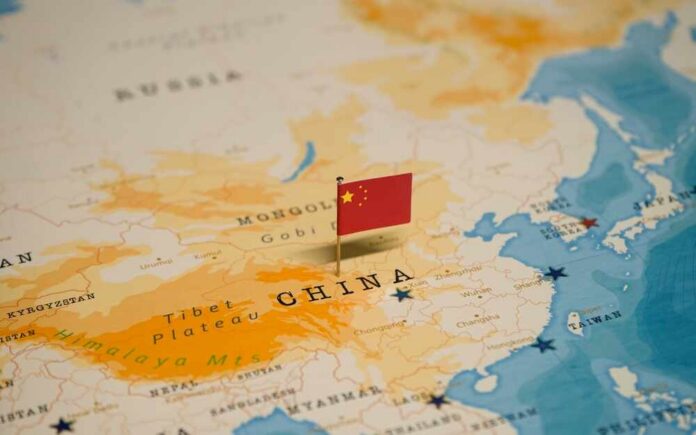
China’s race to field hidden new weapons is forcing Congress to decide whether America will stay ahead—or let Beijing outgun us in our own Pacific backyard.
Story Snapshot
- Adm. Sam Paparo says China is out-producing the U.S. in ships, planes, and missiles and racing ahead in advanced weapons.
- He warns Congress that Beijing is building missiles, space and cyber tools, and “special” space programs that could blind and hit U.S. forces first.
- He is asking for over $100 billion in new Pacific-focused weapons and drones to restore real deterrence.
- Lawmakers must weigh serious China threats against years of Pentagon waste, secrecy, and past political distractions.
Paparo’s Warning: China’s Military Machine Is Surging Ahead
Admiral Samuel Paparo, the Trump administration’s top commander for the Pacific region, is blunt: China is out-producing the United States in air, maritime, and missile capability, and the trajectory has to change.[5] His official posture statement to Congress describes a China that is not just catching up, but trying to leap ahead in every warfighting area that matters. He describes a “historic” military buildup designed to push American forces out of the Western Pacific and intimidate allies like Taiwan and the Philippines.[5]
Paparo reports that in 2024 China’s People’s Liberation Army kept up constant, multi-domain pressure on Taiwan, with more frequent and complex air and naval patrols around the island.[5] He says Beijing combines that military pressure with cyber operations, propaganda, and economic coercion to weaken neighbors without firing a shot.[5] For readers who watched Washington chase woke programs at the Pentagon while cutting real warfighting capability, his testimony underlines a hard truth: while our elites argued about pronouns, China built missiles, ships, and bases.
Secretive Space, Cyber, and Missile Programs Raise the Stakes
In written testimony, Paparo warns that China is rapidly developing advanced missile systems, space and counter-space capabilities, cyber tools, hypersonic weapons, chemical and biological weapons, and a growing nuclear arsenal.[5] He stresses that these are not narrow programs but a broad-range effort meant to threaten U.S. bases, ships, and satellites across the Pacific. He also notes that U.S. adversaries are building sophisticated anti-satellite weapons and orbital systems that can jam or attack American space assets.[5]
A private report described in the press says Paparo’s latest assessment to Congress includes details on weapons-buying plans and “special space activities” placed inside highly classified special access programs.[7] These appear to be new American systems meant to counter Chinese space and missile threats, but the very secrecy shows how serious both sides are about gaining an edge in orbit.[7] For many conservatives, this kind of hidden arms race is a reminder that America cannot afford a weak military, yet also cannot give the Pentagon a blank check without oversight.
Massive Budget Request: Rebuilding Real Deterrence in the Pacific
To keep deterrence credible, Paparo is asking Congress for about $122 billion for fiscal year 2027 to fund new weapons and support systems.[2] He calls that figure “the minimum investments required” to keep China from miscalculating and to “prevail in conflict if deterrence fails.”[2] The single largest piece is roughly $67.4 billion for new missiles, including long-range cruise and ballistic weapons and new hypersonic missiles designed to punch through Chinese defenses.[2]
He also asks for about $18 billion to hit China’s command, control, communications, cyber, intelligence, surveillance, reconnaissance, and targeting networks—the nervous system that lets Beijing find and fire on U.S. forces.[2] Another $15 billion would go to a space-based missile warning system and battlefield sensors, and $2.3 billion would buy maritime, underwater, and ground-based drones.[2] In separate comments, Paparo has said the United States must expand production of heavyweight torpedoes, long-range anti-ship missiles, Maritime Strike Tomahawk cruise missiles, and advanced air-defense missiles to close the gap.[6]
How This Fight Connects to America First Concerns
Paparo’s warnings land in a country tired of endless wars, open borders, and runaway spending. Trump voters want a strong defense, but they also remember how the political class used “threats” to justify bad deals and foreign adventures. Paparo’s testimony is different in one key way: it focuses on hard production numbers, weapons types, and specific Chinese behavior, not vague fear-mongering. He points to China’s massive missile inventories, nuclear buildup, and constant harassment of Taiwan and other neighbors as concrete signs of danger.[3][6]
🚨 DEVELOPING | Department of War (Jun 16): USINDOPACOM officially renamed US Pacific Command (USPACOM) — dropping 'Indo' after 8 years.
What's confirmed:
→ Name restored to pre-2018 USPACOM designation
→ AOR unchanged — West Coast of US to western border of India
→ Admiral… pic.twitter.com/teXScNouZi— Defense Sight Africa (@defensesightmea) June 17, 2026
At the same time, the public record does not show all the intelligence data behind his claim that China is out-producing America in every domain.[5][8] That leaves room for healthy skepticism about how much new spending is truly needed and how it is managed. For constitutional conservatives, the task is clear: demand that Congress fund real warfighting tools, cut legacy pork and social experiments in uniform, secure supply chains away from China, and keep strict oversight on secret programs so that deterrence stays strong without giving up accountability.
Sources:
[2] Web – Key Points! Testimony by Admiral Samuel J. Paparo …
[3] Web – Indo-Pacific Command chief sounds alarm on China war …
[5] YouTube – 20250409: Full Hearing: U.S. Military Posture and National …
[6] Web – statement of admiral samuel j. paparo commander, us indo …
[7] YouTube – US Defense Officials Testify on Indo-Pacom’s Budget
[8] Web – During the House Armed Services Committee hearing on “ …