A little-known Chinese defense firm is bragging that its artificial intelligence “tracked” four American B‑2 stealth bombers over Iran—without offering a shred of hard proof that it ever touched a single U.S. radio transmission.
Story Snapshot
- Chinese firm Jingan Technology claims its AI system intercepted B‑2 bomber radio signals during U.S. strikes on Iran, but has released no verifiable evidence.
- Open reporting indicates the system mostly fused open‑source data like satellite imagery, aviation tracking, and public records, not classified U.S. communications.
- Analysts stress the claim remains unverified and may be closer to clever internet sleuthing than a stealth‑killing breakthrough.
- The episode highlights how China-linked companies use inflated tech narratives to project power and shape global perception of U.S. military strength.
What Jingan Technology Says It Did Over Iran
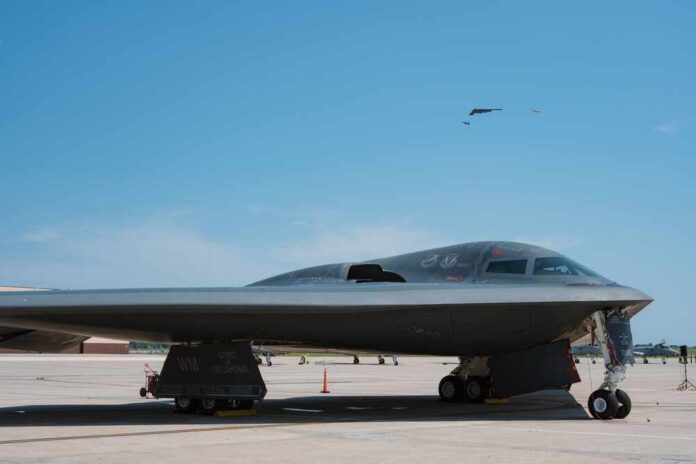
Chinese defense firm Jingan Technology, which provides intelligence services to the People’s Liberation Army, claimed its “Jingqi” war monitoring platform intercepted radio signals linked to four U.S. B‑2 Spirit stealth bombers involved in a March 1 strike on Iranian targets under Operation Epic Fury.[1][3] The company said the system detected communications as the bombers, using call signs “Petro 41” through “Petro 44,” returned from their mission and reconstructed their flight paths back toward the United States.[1][2][3]
Media summaries of Jingan’s statement say the firm even released an audio clip that it asserted contained captured radio traffic associated with the returning B‑2s and posted about the intercept on Chinese social media the following day.[1][2][6][8] Reporting also notes that Jingan markets Jingqi as a global “situational awareness” tool designed to track aircraft, ships, satellites, and military deployments worldwide in near real time, blending artificial intelligence with large volumes of data from many sources.[1][3][7]
How the System Really Works: Open-Source Fusion, Not Magic Ears
Descriptions of the Jingqi platform in independent coverage point to a system built primarily on open‑source intelligence rather than secret penetration of U.S. secure radios.[1][2][3][7] South China Morning Post reports that Jingqi integrates satellite imagery, aviation trajectory data, and public military records to interpret transport routes, reconnaissance patterns, base activity, and aircraft carrier group movements.[3] NineteenFortyFive likewise explains that the system reconstructed bomber flight paths using aviation tracking feeds and satellite images rather than only raw intercepted signals.[2]
Defense reporting adds that Jingan said its tools identified early indicators of U.S. military buildup around Iran weeks before the strike by analyzing public data, including open‑source information about deployments and tanker movements.[1][3] A related Chinese geospatial firm, MizarVision, separately published analysis showing how refueling tankers broadcasting their position via public flight‑tracking signals can reveal likely bomber activity, again underscoring how much can be inferred without breaking into secure American communications.[4]
Why Experts Call the Claim “Unverified” and Possibly Exaggerated
Western analysis has been blunt that Jingan’s story is not proven. NineteenFortyFive notes that the company’s claims “remain unverified,” stressing that no independent party has seen raw intercept data, detailed collection logs, or technical parameters confirming that genuine B‑2 radios were captured.[2] A detailed brief from Kharon cites an expert who argues that Jingan’s route reconstruction was “likely less a product of interception than of inference,” built from prior knowledge of U.S. bomber operations and open‑source indicators rather than direct access to stealth aircraft communications.[8]
Several outlets highlight that while Jingan and sympathetic coverage refer to “intercepted” or “captured” signals, the public record offers no original waveform files, full transcripts, or spectrum analysis that would allow outside specialists to validate the intercept.[1][2][3][5][8] One technical explainer video reviewing available screenshots and descriptions states that presenting the story as China “tracking” B‑2s in real time by radio is “fake news,” arguing that Jingan’s real accomplishment was automated correlation of social media, flight‑tracking sites, air traffic control recordings, and tanker operations to reconstruct the mission after the fact.[7]
What This Means for U.S. Stealth, China’s Propaganda, and American Patriots
From a defense‑technology standpoint, nothing in the public record demonstrates that Jingan has cracked the core survivability of the B‑2 or pierced U.S. secure communications; instead, the episode illustrates how much modern conflict can be mapped from commercial data and open sources when fused by artificial intelligence.[1][2][3][4][7] Analysts note that even if no true intercept occurred, the story serves Beijing’s interests by suggesting that Chinese firms can see through America’s most advanced stealth assets.[2][3][8]
For U.S. conservatives who value a strong military, limited government, and honest accounting of threats, the key takeaway is twofold. First, American forces remain technologically dominant, but sloppy public data practices—from unsecured tanker tracking to oversharing on social media—can hand adversaries free intelligence that Washington’s bureaucracy is slow to lock down.[2][4][7] Second, China’s blend of state‑linked companies and media amplification turns unproven technical claims into tools of information warfare aimed at undercutting U.S. deterrence in the eyes of the world.[3][8]
Sources:
[1] Web – A Chinese defense firm claims its AI tracked four US B-2 stealth …
[2] YouTube – Chinese AI System Claims Signal Intercept Linked to …
[3] Web – A Chinese Tech Firm Says It Tracked Radio Signals from B-2 Spirit …
[4] Web – China claims it intercepted radio signals from US B-2 bomber over Iran
[5] Web – A Chinese AI Startup Said It Tracked U.S. Stealth Bombers Over Iran …
[6] Web – Chinese AI Monitoring System Allegedly Tracked US B-2 Bombers …
[7] Web – Chinese firm claims it intercepted B-2 radio signal during US strike …
[8] YouTube – The Chinese Tracked the B2 in an UNEXPECTED way