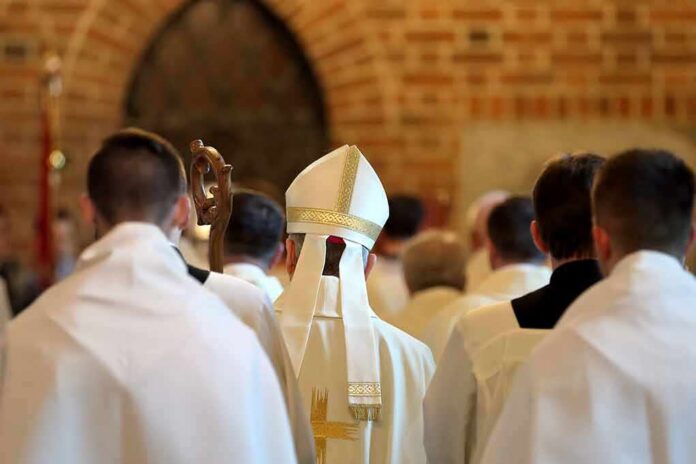
Cardinal Reinhard Marx said priests who support women’s ordination are no longer automatically barred from becoming bishops, signaling a shift in how Church leaders are chosen in Germany.
Story Snapshot
- Cardinal Marx described a change in episcopal selection: support for women’s ordination no longer disqualifies candidates.
- Marx tied the shift to recent appointments but did not name examples or documents.
- Official Catholic teaching still holds women cannot be ordained as priests and that this must be held definitively.
- The bishop selection process is confidential, making claims hard to verify from public records.
What Cardinal Marx Said and Why It Matters
Cardinal Reinhard Marx said, “Ten years ago, no one who could imagine the ordination of women would have been considered as a candidate for bishop. That’s over now,” describing a change he linked to appointments in Germany. The claim points to a climate shift in evaluating candidates, not a change in doctrine or canon law. Marx also challenged the idea that arguments against women’s ordination should come only from men’s circles, pressing for broader debate on leadership roles.
Marx did not name specific bishops or share documents to prove the hiring shift. That gap makes the claim hard to test in public. But his remarks fit wider German debates about the Synodal Way and reform, where leaders weigh tradition against calls for change in governance and ministry. The comment places selection practice under a spotlight and invites questions about how much private screening has moved in recent years.
The Doctrinal Baseline Has Not Changed
St. John Paul II’s 1994 apostolic letter stated the Church has no authority to ordain women as priests and that all the faithful must hold this judgment definitively. The Vatican’s doctrinal office later confirmed this teaching requires definitive assent and is taught infallibly by the ordinary and universal Magisterium. These texts remain the formal standard. Marx’s claim addresses candidate eligibility in practice, not a doctrinal reversal or a green light for women’s priestly ordination.
Traditionalist critics argue that public support for women’s priestly ordination conflicts with the duty of a bishop to teach and guard settled doctrine. They say such support signals a break with definitive teaching and should remain disqualifying. Marx’s framing, by contrast, suggests that some Church leaders now judge a candidate by a wider set of traits, even if he entertains change on this issue. Neither side cites a new rule. The tension lies between practice and teaching, not in a new decree.
How Bishops Are Chosen, and Why Proof Is Scarce
The selection process moves through confidential consultations, starting locally and passing through the apostolic nuncio and the Dicastery for Bishops, before the Pope decides. The United States Conference of Catholic Bishops describes this process as bound by strict confidentiality, with many voices giving input across months. Because files and interviews are private, the public often relies on indirect clues, later statements, or patterns in appointments rather than official criteria.
That secrecy explains the current evidence gap. Marx’s statement is clear and attributable, but it lacks named appointments and documents. Supporters see a real shift in how leaders weigh issues and pastoral style. Skeptics see an anecdote that risks normalizing dissent. Both can be true in part. This moment shows how institutions can change by habit and hiring, even when formal doctrine stands firm. The lack of clarity feeds mistrust that many citizens now feel toward powerful institutions.
Why This Resonates Beyond the Church
People across the political spectrum see a familiar pattern: rules say one thing, insiders do another. Many Americans feel that elites rewrite norms in private while telling the public nothing has changed. This story fits that fear. The Church’s teaching is public and firm. The selection process is private and flexible. When leaders signal a shift without details, it can look like change by stealth. That erodes trust, even among those open to reform.
What To Watch Next
Watch for three signs. First, a formal Vatican clarification on whether support for women’s priestly ordination affects suitability for the episcopacy. Second, named examples that match Marx’s claim, with public records of views before appointment. Third, future appointments in Germany and beyond. If a pattern emerges, the shift is real in practice. If not, the remark may reflect local debates rather than a wider rule change.
Sources:
lifesitenews.com, advaticanum.com, dbk.de, catholicculture.org, vatican.va, academia.edu