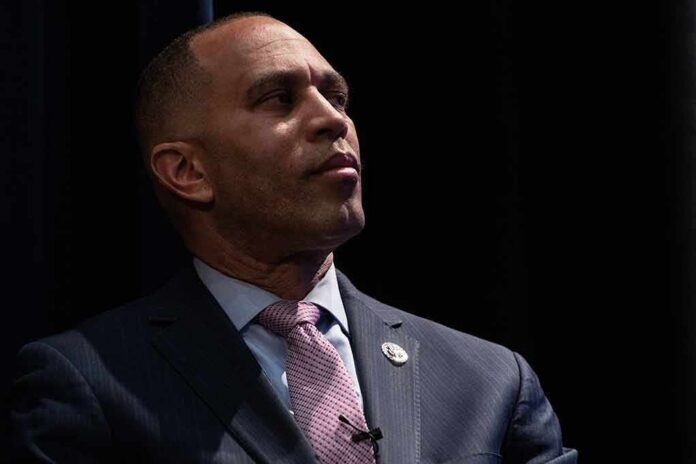
House Democrats handed Hakeem Jeffries a 251–11 nomination win, putting him on the brink of becoming the first Black Speaker while exposing a small but vocal left-wing split.
Story Highlights
- Jeffries won the Democratic nomination 251–11 in a closed caucus vote.
- He ran unopposed and has led House Democrats since 2023.
- Democrats say they will hold the House majority next year, setting up a floor vote.
- Progressives registered dissent over health care and Israel policy, leaving negotiations to finish.
What Democrats Decided Behind Closed Doors
House Democrats nominated Hakeem Jeffries for Speaker with a 251–11 vote in a closed-door caucus election. Reports from National Public Radio and others described a strong win that came without an opponent on the ballot. ABC News and the New York Times said the vote puts Jeffries in line to make history as the first Black Speaker if the full House elects him in January. The tally shows broad party backing, even as a small group registered no votes.
Jeffries has served as the top House Democrat since 2023, after succeeding Nancy Pelosi, so members know his leadership style and record. His campaign to be Speaker began with a formal “Dear Colleague” letter on November 4, where he asked for support to become the fifty-seventh Speaker of the House. That letter set a clear bid from an established leader. People magazine and the Washington Examiner each described him as running unopposed in the caucus.
Why This Matters For Control Of Congress
Democrats say they will have the House majority in the new Congress, which gives their nominee a real path to the gavel rather than a protest role. Still, the caucus vote is not the final step. Jeffries must win a majority on the House floor, which usually means at least 218 votes, depending on attendance. That public vote will test whether today’s unity holds when it counts, and whether the dissenters come on board.
The gap between nomination and the floor vote often becomes a leverage point. Members use it to win policy promises, committee roles, or rule changes. Congressional researchers note that internal dissent during Speaker elections has become more common in recent decades, even when parties appear unified in public. That pattern explains why the 251–11 win shows strength, yet still leaves real work before the final vote.
The Fault Line: Health Care And Israel Policy
Progressive Democrats pushed Jeffries for firmer commitments on Medicare for All and on limiting United States weapons transfers to Israel. Reuters reported visible protests at a Democratic conference where attendees demanded government-funded care and an arms embargo. CBS News and other outlets said seven of the no votes came from new progressive members seeking specific promises, while talks showed “meaningful progress” but were not done. ABC News also linked the dissent to Gaza and immigration concerns.
Hakeem Jeffries won the House Democrats' nomination for Speaker by a vote of 251 to 11 in a secret-ballot caucus election on November 18, 2026.
Only 11 extremists voted against him!— Diane H 🇺🇸 🇮🇱 🇮🇷 🇺🇦 ✡ (@DianeB528) November 18, 2026
CNN reported that some newly elected Democratic socialists withheld early support while pressing for votes on Medicare for All or a ban on arms sales to Israel. These demands mirror years of activist pressure on Democratic leaders. Advocates say working families face rising medical bills and global crises that do not match Washington’s pace. Party leaders counter that they must craft bills that can pass both chambers and survive the nation’s divided politics.
What Both Sides Of America Can See Here
Many Americans, on the right and the left, see a Congress that too often protects insiders first. This story cuts to that concern. The vote was private, the negotiations are private, and the final policy deals are not public yet. Supporters call this normal caucus practice. Skeptics hear familiar backroom bargaining. The outcome will affect spending, health care debates, and United States policy in the Middle East. Voters deserve clear goals and public timelines after the floor vote.
What Comes Next On The House Floor
Jeffries enters the floor vote with momentum, a united leadership team, and a historic milestone within reach. The key questions now are simple. Do the 11 holdouts get written commitments they can explain to voters? Do moderates and progressives agree on a first-month agenda that shows results people can feel at home? The House will answer those questions soon. Until then, the nomination is a major step, not the finish line.
Sources:
redstate.com, npr.org, abcnews.com, jeffries.house.gov, people.com, washingtonexaminer.com, nytimes.com, cnn.com