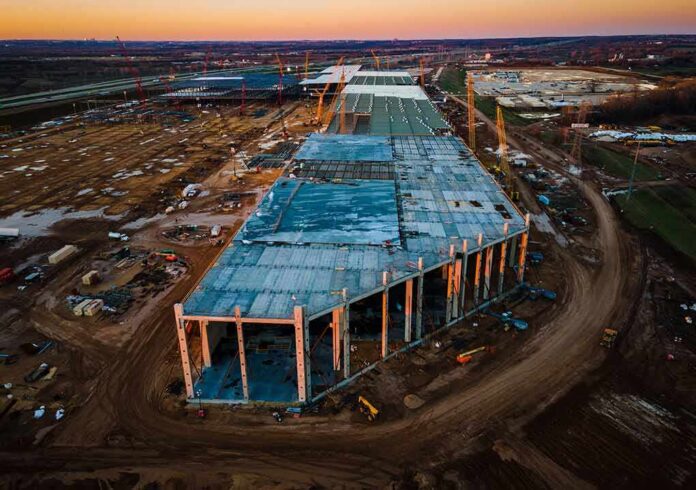
The fight over how to license small reactors is no longer an abstract policy debate; it now lives inside a live construction docket in Texas, where a startup is asking the Nuclear Regulatory Commission (NRC) for early foundation work while simultaneously arguing in federal court that the agency’s core licensing trigger sweeps too broadly for small, lower-risk machines.
The Short Version
- Last Energy has filed Part One of a phased construction-permit application for its PWR-5 at the Caldwell site in Texas and asked the NRC for a Limited Work Authorization to begin subsurface and foundation activities.
- The company is using a defined regulatory pathway: a Part 50, two-step licensing process with an explicit Limited Work Authorization request, rather than an informal or ad hoc approach.
- In parallel, Last Energy and several states are challenging the NRC’s “utilization facility” definition in court, contending it unlawfully ropes all reactors—regardless of size—into full NRC licensing.
- DOE reviewed the PWR-5 in a pilot context, but that does not translate into a commercial construction or operating license from the NRC.
- This case sits at the center of the long-running tension between risk-proportionate regulation and the uniformity and public assurance of the NRC’s traditional framework.
What the application actually asks the NRC to allow
Last Energy’s filing is not a generic “let us build.” It is the first piece of a phased construction-permit application under 10 CFR Part 50 and, critically, it includes a request for a Limited Work Authorization (LWA) under 10 CFR 50.10(d). An LWA is a bounded tool: it allows certain site and foundation activities before a full construction permit, but only if the NRC is satisfied on the safety and environmental fronts specific to that scope. The NRC’s Federal Register notice confirms receipt of Part One and the LWA request for the Caldwell site in Caldwell County, Texas; the enumerated work packages include subsurface preparation, grout backfill, placement of a steel liner, and driving steel H-piles for the reactor-vessel foundation. Receipt is not approval. But it sets a formal review in motion—completeness checks, potential requests for additional information, environmental scoping, and, if warranted, a staff safety determination on the limited activities proposed.
The procedural choice matters. By filing under 10 CFR 2.101(a)(9) for a Class 103 (commercial) construction permit and invoking the LWA provision in 10 CFR 50.10(d), Last Energy is squarely within established pathways the agency has used for decades, adapted in recent years for small reactors. This is not an attempt to short-circuit review; it is an attempt to sequence it logically to de-risk the civil works before the full nuclear island proceeds.
How Last Energy argues it is qualified to build—and what that does and does not prove
Part One applications concentrate on the applicant’s institutional footing and the site work in question. Last Energy’s NRC-hosted materials describe the company’s nuclear-safety and regulatory experience, engineering leadership for safety-critical systems, and specialized support for site characterization, geotechnical work, and construction planning. They also point to participation in the Department of Energy’s (DOE) Reactor Pilot Program and DOE approval of a Preliminary Documented Safety Analysis for the PWR-5 at the Texas A&M-RELLIS pilot setting. These are relevant indicators of readiness. But their legal weight is limited: a DOE pilot authorization is not a commercial construction or operating license, and the PWR-5’s DOE-reviewed safety basis does not substitute for the NRC’s site-specific findings at Caldwell. The NRC record to date does not include a completed staff safety evaluation for the Caldwell project or an approval of the requested LWA.
This distinction—DOE pilot evaluation versus NRC commercial licensing—often confuses observers. DOE’s pilot work can accelerate learning, identify hazards early, and generate documented analyses. Yet the Atomic Energy Act assigns commercial licensing to the NRC; the agency will map and credit analysis where appropriate, but it must make its own determinations on siting, external hazards, foundations, emergency planning, security, quality assurance, and the reactor’s safety case. Expect NRC staff to probe seismic and subsurface data, foundation design calculations, and construction sequencing before issuing any LWA decision.
The legal gambit: challenging the NRC’s licensing trigger while seeking an NRC permit
In parallel with the permit filing, Last Energy—joined by Texas and Utah, and later by Louisiana in related advocacy—has mounted a direct challenge to the NRC’s definition of “utilization facility” in 10 CFR 50.2. Their theory in Texas v. NRC is straightforward: by treating all reactors as utilization facilities that require full NRC licensing, the rule exceeds what the Atomic Energy Act authorizes for very small or inherently lower-risk units. If that theory prevails, microreactors or certain small light-water units might face a different regulatory gate. If it fails, the current framework remains intact.
There is practical tension here. The company is seeking relief from the very regime it is using to advance the Texas project. That is not hypocrisy; it is hedging. Litigation timelines and market timelines rarely align; developers often prosecute a license while preserving legal arguments against elements of the process. For the NRC, the case creates institutional uncertainty that staff will manage by sticking to the books—applying existing regulations until a court says otherwise. For investors and local stakeholders, the court fight is noise unless and until it changes what the Caldwell docket requires. As of now, it does not.
How the NRC is modernizing—and what still anchors its reviews
Even as the Texas lawsuit proceeds, the NRC has been codifying more risk-informed, technology-inclusive tools. Small modular reactors (SMRs) can use the traditional two-step Part 50 process or Part 52; the agency’s newer Part 53 adds a performance-based option designed to maintain safety outcomes equivalent to Parts 50 and 52 while offering flexibility in how applicants demonstrate them. Part 53 leans on probabilistic risk assessment and other systematic evaluations to proportion effort to risk—an approach that, if executed well, trims needless paperwork while sharpening focus on the few things that truly matter for public protection.
Importantly, modernization has not erased the fundamentals. Whether under Part 50, 52, or 53, NRC reviews still interrogate site characteristics, systems and structures important to safety, accident analysis, emergency preparedness, radiation protection, quality assurance, human factors, and severe-accident behavior, among other areas. The primary safety function remains the same: limit radioactive material releases during routine operations and credible licensing-basis events over the plant’s life. That continuity explains why an LWA for foundation work still competes for geotechnical rigor; no framework allows rebar and H-piles to proceed on hope.
Where the genuine uncertainties lie
Three unknowns will determine whether Caldwell moves from paperwork to pilings. First, the NRC’s technical view of the site and foundation package: staff must be satisfied that subsurface conditions, seismic inputs, and foundation design are adequate for the proposed scope before issuing an LWA. The current public docket confirms only that the application and LWA request were received, not approved. Second, the completeness and credibility of the broader safety case as Part Two arrives—defense-in-depth features, transient and accident performance, emergency planning tailored to a small PWR, and the quality of the programmatic controls that keep construction and operation disciplined. Third, the litigation’s outcome: if a court compels a narrower licensing trigger for small units, Caldwell’s regulatory posture could shift; if not, expect the project to continue under familiar NRC authorities.
Outside the courtroom, market and policy currents also matter. The Government Accountability Office has long documented how licensing cost and schedule risk reinforce demand uncertainty for novel reactors; the agency and Congress have responded with staffing, process, and fee reforms meant to improve predictability without diluting safety. Modernization will help only if applicants deliver complete, high-quality submittals and choose the framework that fits their design and business model.
$OKLO Q3 2026 earnings: Oklo builds quickly, but its first plant may start later
Oklo's construction is moving quickly, but its first power plant now has a later start date. Steel is going up at Aurora-ID in Idaho, and chief executive Jacob DeWitte priced the Groves-1 test… pic.twitter.com/bfCRgfgZ3E
— Finsee (@Finsee_main) November 6, 2026
What to watch next
Focus on evidence that moves risk, not rhetoric. On the licensing side: NRC requests for additional information on Caldwell geotechnical data; any staff environmental findings scoped to the LWA; and, ultimately, a staff safety evaluation approving or denying the limited work. On the design side: whether Last Energy’s PWR-5 avoids a thicket of exemptions by staying close to well-understood light-water technology, and whether its programmatic controls—quality assurance, construction oversight, and corrective action—look mature for a first-of-a-kind build. On the legal side: substantive rulings in Texas v. NRC that address the utilization-facility definition rather than procedural skirmishes. Each development will speak directly to the core question here: can a small, standardized light-water reactor be licensed on a proportionate timeline while preserving the bedrock assurance the NRC was created to provide?
Sources:
zerohedge.com, federalregister.gov, nrc.gov, haynesboone.com, world-nuclear-news.org, autonocion.com, gao.gov