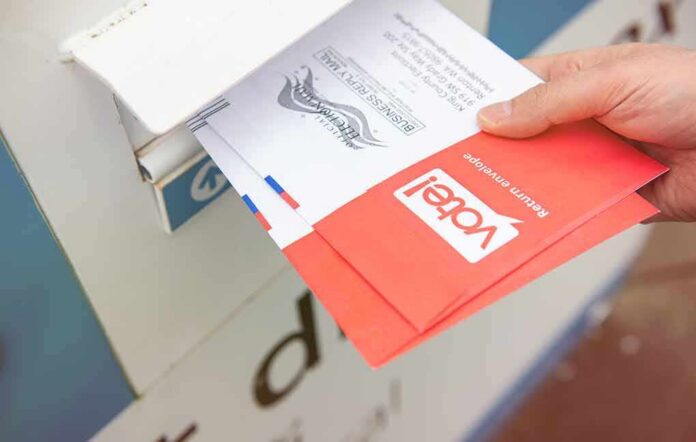
After weeks of courtroom clashes, the Justice Department abruptly dismissed its case to set aside thousands of California mail ballots flagged as “likely” noncitizen votes.
Story Snapshot
- Justice Department ended its lawsuit seeking to halt counting of flagged California mail ballots.
- Courts questioned the timing, authority, and feasibility of the federal request.
- County review found many false positives and limited evidence of actual voting.
- The fight exposed how big data claims can outrun what officials can verify before deadlines.
What DOJ Alleged And Why It Mattered
On October 15, the Department of Justice filed a lawsuit claiming that more than 20,000 “likely” noncitizens were on California’s voter rolls. The filing asked a federal judge to make the state set aside related mail ballots until citizenship could be verified, to prevent dilution of lawful votes. The department cited an inquiry by Homeland Security Investigations, a division of Immigration and Customs Enforcement, as the source of the list. The move set off a fast, high-stakes legal fight weeks before ballots were counted.
Federal lawyers argued they were protecting election integrity with a targeted remedy. They did not ask to stop the election or toss all mail ballots. They wanted ballots tied to flagged names held back and checked. The request hinged on whether their data matched real, ineligible voters and whether a court could order counties to change process days before statutory deadlines. Those questions would dominate the court’s response and the public debate.
How Courts Pushed Back On Process And Timing
The United States Court of Appeals for the Ninth Circuit raised sharp concerns about the lawsuit’s timing and legal footing. Judges noted that California’s mail ballot system runs on tight, state-set schedules, and they questioned federal authority to force last-minute segregation of ballots without clear statutory backing. A district judge then declined to block counting, saying the requested fix was not supported and was impractical so close to tabulation. These rulings narrowed DOJ’s options fast.
After those setbacks, the Justice Department moved to dismiss its own case. The voluntary dismissal ended any chance of a court-ordered ballot hold in this election cycle. The outcome let state and county officials claim victory on process grounds, while leaving unresolved how many flagged records, if any, involved true noncitizens. The legal blow did not prove the list was wrong. It showed the requested remedy came too late and with too little verified detail.
What The Data Checks Actually Found
Los Angeles County reviewed a 200-person sample from the federal list. The county reported that 112 had canceled or inactive registrations and were not mailed ballots. Of the rest, 86 were mailed ballots. About 71 percent of the sample had no voting history in the last election. County officials also said that among records with useful birthplace data, 38.9 percent showed United States birth, which strongly signals citizenship. These findings suggested many false matches.
We're not saying it was stolen. We're saying prove it was clean.
Before Election Day:
• DHS flagged more than 256,000 possible noncitizens on the voter rolls in just four states
• DOJ charged 239 people with voting crimes
• Courts refused to set aside 20,000 California ballots… pic.twitter.com/nY8fE0qtRZ— Kyle Brown (@KyleB_1990) November 7, 2026
Separate media analysis reported the list did not align cleanly with California’s current voter file. One review found that 8,880 of 20,930 names—about 42 percent—did not match anyone on the state’s active rolls. Another report said only a fraction of the total list tied to Los Angeles County addresses, with duplicates included, complicating any effort to hold ballots countywide. None of these reviews proved there were zero improper registrations. They did show the initial “20,000” claim likely overstated the scope.
The Bigger Pattern: Big Numbers, Few Verified Cases
Election research across many states shows that suspected noncitizen voting is rare compared with total ballots cast. A study covering 23.5 million votes in 2016 found about 30 suspected noncitizen-voting incidents referred for investigation—roughly one in a million ballots. Experts warn that large database matches often produce errors when records are old, incomplete, or duplicated. That is why officials stress verification of individuals over raw match counts.
Both sides share legitimate concerns. Voters want clean rolls and fair counting. They also want government to avoid last-minute chaos that risks voiding lawful votes. This episode showed both problems at once: a sweeping federal claim built on opaque data and a court system that could not support a late fix without clear proof and legal authority. The case ended, but the trust gap remains. Durable solutions need earlier data-sharing, stronger list maintenance, and fast, transparent individual checks before ballots go out.
Sources:
mediaite.com, nbcnews.com, nytimes.com, kcra.com, apnews.com, npr.org, cnn.com, sfchronicle.com, democracydocket.com, stevevladeck.com