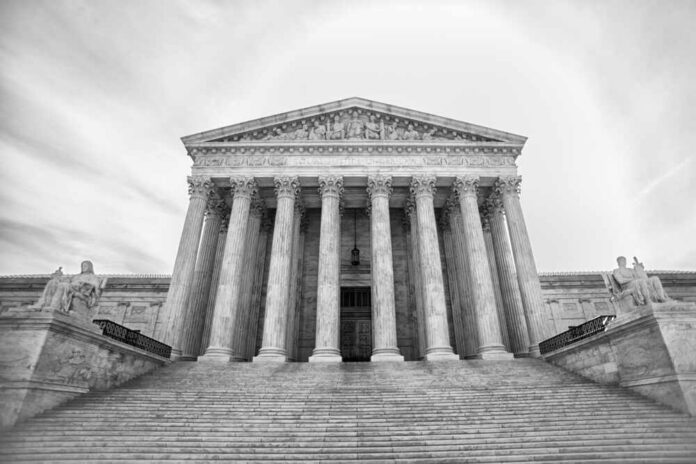
A federal court has once again stepped into Alabama’s redistricting fight, blocking the state’s map and demanding race-driven lines that could reshape Congress far beyond one Southern state.
Story Snapshot
- A federal court blocked Alabama’s latest congressional map and pushed for two districts where Black voters can elect their preferred candidates.
- Judges leaned on the Voting Rights Act to demand race-conscious line-drawing, even as the Supreme Court has just limited race-based redistricting in Louisiana.[2]
- The clash highlights a growing conflict between lower courts that want more majority-Black districts and a Supreme Court warning against racial gerrymandering.[2]
- The outcome could influence maps nationwide, raising core questions about equal protection, colorblind law, and whether Congress is picked by voters or by judges.
Federal Court Pushes Alabama Toward More Race-Based Districts
A three-judge federal court panel struck down Alabama’s congressional map and ordered lawmakers to draw a new plan that creates two districts where Black voters have a realistic opportunity to elect their preferred candidates.[1] The court relied on Section 2 of the Voting Rights Act, concluding that the state’s existing map, with only one majority-Black district, likely diluted Black voting strength in violation of federal law.[1] This order effectively requires race-conscious district design.
The ruling came out of a lawsuit filed in late 2021 on behalf of Greater Birmingham Ministries, the Alabama State Conference of the National Association for the Advancement of Colored People, and several individual voters.[1] Civil rights groups argued that Alabama’s map unlawfully packed many Black voters into a single district while cracking others across multiple majority-white districts, minimizing their political influence.[1] The panel agreed that a remedial map must include two districts where Black voters have an opportunity to elect candidates of their choice.[1]
Supreme Court Signals a Turn Away From Racial Gerrymandering
While lower courts continue to press states like Alabama toward additional majority-Black districts, the Supreme Court has moved in a different direction, especially in its recent decision in Louisiana v. Callais.[2] In that case, the Court struck down Louisiana’s congressional map as an unconstitutional racial gerrymander, holding that the state’s effort to create a second majority-Black district relied too heavily on race without a compelling constitutional justification.[2] Justice Alito’s majority opinion emphasized strict limits on race-based redistricting.[2]
The Callais decision clarified that when race predominates in drawing district lines, those plans must survive “strict scrutiny” under the Equal Protection Clause, meaning the state must show a compelling interest and narrow tailoring.[2] The Court concluded that Section 2 of the Voting Rights Act did not require Louisiana to adopt the heavily race-driven map it used as a remedy, and therefore the state could not justify the racial gerrymander on that basis.[2] Commentators note that this ruling significantly narrows when Section 2 can be used to demand additional majority-minority districts.
Alabama Case Sits at the Crossroads of Voting Rights and Equal Protection
The Alabama dispute illustrates how difficult it has become for courts to separate race from partisanship in redistricting, especially in states where voting remains racially polarized. The Columbia Law Review describes a long-standing tension between Section 2 vote-dilution doctrine, which often pushes mapmakers to consider race to avoid cracking or packing minority voters, and constitutional rulings that condemn race-based districting as discriminatory gerrymandering. The Court’s newer jurisprudence has sharpened this conflict by demanding more evidence that Section 2 truly requires race-conscious maps.[2]
For Alabama, this means lawmakers are being told by one court to design districts explicitly protecting Black electoral opportunity, while Supreme Court precedent warns that race cannot be the predominant factor in drawing lines without violating the Fourteenth Amendment.[2] The National Conference of State Legislatures explains that Callais “fundamentally altered” the framework for deciding when the Voting Rights Act mandates additional majority-minority districts, now requiring judges to more carefully distinguish racial motives from partisan ones. This evolving standard will influence how Alabama’s revised map is evaluated going forward.
What Is at Stake for Voters, Representation, and Constitutional Principles
These redistricting battles carry major national consequences, because every additional majority-Black district in states like Alabama and Louisiana tends to elect Democrats and can shift the balance of power in the House of Representatives. Civil rights advocates argue that additional Black-opportunity districts are needed to prevent vote dilution and ensure that minority communities can elect candidates responsive to their interests.[1] They frame federal court intervention as necessary to counter structural disadvantages built into traditional maps.[1]
I agree with Louisiana v. Callais that redistricting should not illegally discriminate based on race. I hope the Supreme Court applies its longstanding doctrine to stop this errant decision in Alabama
— Eric W. (@EWess92) May 26, 2026
Critics of race-based mapping, including some legal scholars and state officials, respond that using skin color as the dominant organizing principle for political districts undermines equal treatment and risks hardening racial divisions in public life.[2] The Supreme Court’s insistence that race cannot predominate absent a clear legal necessity reflects a growing concern that judicially imposed majority-minority districts can slide into unconstitutional racial sorting.[2] As Alabama redraws its map under federal pressure while watching Callais reshape the legal landscape, the country is watching to see whether redistricting will move toward a more genuinely colorblind approach or further entrench race in the heart of American politics.
Sources:
[1] Web – The Supreme Court’s Callais decision sets new framework for racial …
[2] Web – [PDF] 24-109 Louisiana v. Callais (04/29/2026) – Supreme Court