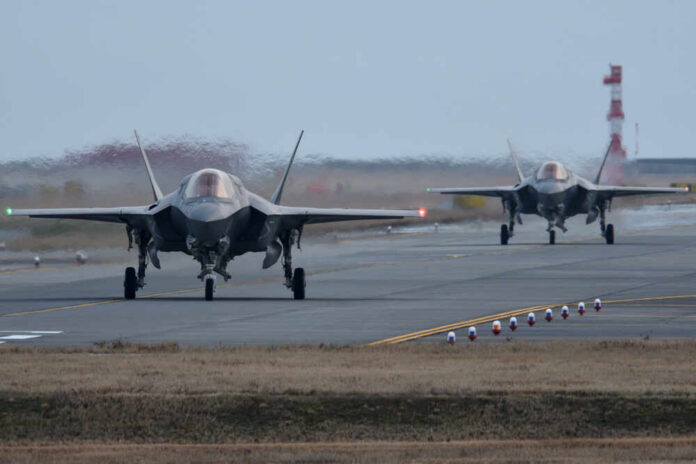
The U.S. Air Force’s F-47 Next Generation Air Dominance fighter represents the most critical aviation program in decades, with military leaders warning that failure to deliver this sixth-generation aircraft could cost American lives in future conflicts with near-peer adversaries like China.
Story Snapshot
- President Trump signed a $20 billion contract with Boeing in spring 2025 to produce 185 F-47 NGAD fighters, each capable of commanding up to 8 AI-driven drones for a total force of 1,500 combat platforms
- The F-47 features revolutionary capabilities including Mach 2+ speed, 1,000+ nautical mile combat radius doubling the F-22’s range, advanced stealth, and AI-driven sensor fusion designed to dominate China’s J-20 and J-35A fighters
- Production is underway with the program “on track” for a 2028 first flight, representing a paradigm shift in air warfare through manned-unmanned teaming that could render traditional air combat calculations obsolete
- The program’s existential stakes reflect growing concerns about America’s ability to maintain air superiority in the Indo-Pacific as China accelerates its military modernization, with delays potentially exposing vulnerabilities in the aging F-22 fleet
Boeing’s Existential Victory Under Trump Administration
Boeing secured the F-47 NGAD contract in spring 2025 after defeating Lockheed Martin in what defense analysts described as an existential competition for the struggling aerospace giant. President Trump personally championed the $20 billion deal, declaring there has “never been anything even close” to the F-47’s capabilities in speed and payload capacity. The contract award marked a critical turning point for Boeing following years of commercial aviation setbacks and represented a political victory for the Trump administration’s America First defense industrial strategy. The program’s acceleration under Republican control contrasts sharply with previous years of cost debates that nearly canceled NGAD when per-unit estimates approached $300 million.
‘Failing Could Cost Lives’: Why the F-47 NGAD Is the Air Force’s ‘Most Important’ Fighter Everhttps://t.co/nfepJ6XorT
— 19FortyFive (@19_forty_five) May 6, 2026
Boeing’s win shifted defense contracting power away from Lockheed Martin, the incumbent producer of the F-22 Raptor and F-35 Lightning II. Industry observers noted the decision reflected Air Force priorities favoring range and sustainability over Lockheed’s incremental improvements to existing platforms. The contract provides Boeing with critical defense revenue as it ramps production at facilities in St. Louis and Missouri, sustaining thousands of high-skilled manufacturing jobs. Defense analysts emphasized the strategic timing, with production beginning in early 2026 as tensions with China over Taiwan reach critical levels. The Trump administration’s rapid contract execution demonstrates a decisive approach to addressing capability gaps that previous administrations allowed to fester through bureaucratic delays.
Revolutionary Capabilities Designed for Pacific Theater
The F-47 incorporates sixth-generation technologies specifically tailored to counter China’s anti-access/area denial strategies in the Indo-Pacific. The aircraft’s 1,000-plus nautical mile combat radius doubles the F-22’s operational range, enabling deep strikes without vulnerable tanker support in contested airspace. Air Force leadership has stressed this extended range addresses the “tyranny of distance” challenge in the Pacific theater where vast ocean expanses separate forward bases from potential conflict zones. The jet’s Mach 2+ speed, advanced stealth coatings, and sensor fusion systems provide capabilities designed to penetrate sophisticated air defense networks that defend Chinese military installations and naval assets across the South China Sea and Taiwan Strait.
Beyond traditional fighter attributes, the F-47 functions as a quarterback for network-centric warfare, commanding up to eight Collaborative Combat Aircraft drones per manned platform. This force multiplication transforms 185 F-47s into a fleet of 1,500 combat platforms capable of overwhelming enemy air defenses through coordinated swarming tactics. The AI-driven drone integration enables missions including targeting, hypersonic weapon delivery, and directed energy weapon deployment while keeping human pilots outside immediate threat ranges. Military commentators describe this manned-unmanned teaming as a paradigm shift that fundamentally alters air combat mathematics, providing asymmetric advantages against numerically superior adversaries. The modular design philosophy allows rapid technology insertion as threats evolve, addressing sustainability concerns that plagued earlier fighter generations.
High Stakes Amid Growing China Threat
Military strategists frame the F-47 program’s success or failure in existential terms for American air superiority. China’s deployment of J-20 stealth fighters since 2017 and development of the carrier-based J-35A represent the first credible peer challenge to U.S. air dominance since the Cold War. The aging F-22 fleet, limited to 187 operational aircraft with production ended in 2011, faces increasing strain maintaining readiness against expanding Chinese capabilities. Delays in F-47 delivery would force the Air Force to rely on inadequate platforms in potential Taiwan conflict scenarios where air superiority determines outcomes. This vulnerability explains the “could cost lives” framing, as outdated aircraft reduce pilot survivability and mission effectiveness in high-intensity combat against modern integrated air defenses.
The program’s 2028 first flight target and planned operational deployment by the early 2030s align with defense intelligence assessments of China’s military modernization timeline. Congress and the Department of Defense must balance the estimated $55 billion total program cost against the catastrophic consequences of losing air dominance in the Pacific. The F-47 represents not merely an incremental upgrade but a generational leap essential for deterring Chinese aggression and reassuring regional allies dependent on American security guarantees. Critics note the classified nature of many specifications creates accountability challenges, yet the consensus among defense experts supports the program’s strategic necessity. The contrast between this urgent development pace and decades of Pentagon acquisition dysfunction reflects hard lessons from watching adversaries close capability gaps while bureaucrats debated requirements.
Sources:
Why Boeing’s F-47 NGAD Next-Gen Fighter Win Was Existential for the Company – Breaking Defense
Don’t You Dare Think the F-47 NGAD Is Just Another Stealth Fighter – National Security Journal
F-47 Program on Track for 2028 Flight – Air & Space Forces Magazine