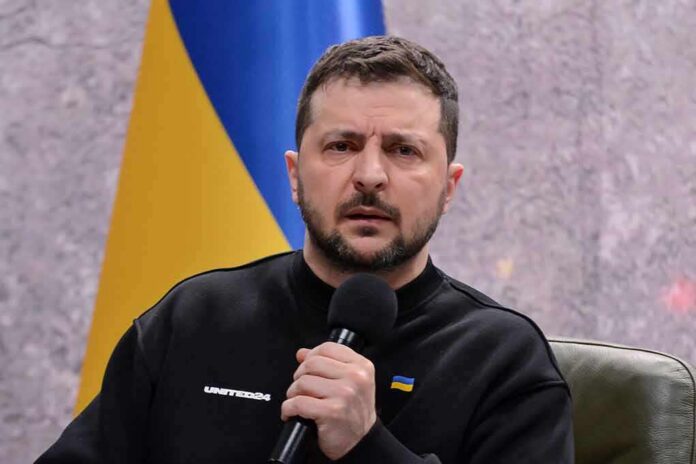
Ukraine’s president and Kyiv’s mayor are publicly clashing over winter readiness while Russian strikes test the capital’s energy lifelines.
Story Snapshot
- President Volodymyr Zelenskyy says Kyiv missed most resilience plan deadlines and must fix gaps fast.
- Kyiv Mayor Vitali Klitschko says power-and-heat plants are ready and a backup heating network is underway.
- The National Security and Defense Council reviewed regional plans and approved Kyiv’s plan amid grid attacks.
- Experts say centralized heat is a wartime risk, pushing cities toward more local backup solutions.
Zelenskyy’s Warning on Missed Deadlines
President Volodymyr Zelenskyy said on October 9 that Kyiv authorities failed to carry out almost all required steps in the city’s resilience plan. He called the delays “absolutely unacceptable” and ordered urgent fixes to protect energy, heat, and water systems as winter nears. He tied the critique to a formal review of regional plans, not just a public rebuke. The message was blunt: the capital must close gaps now because residents already feel strain from repeated strikes.
Ukraine’s National Security and Defense Council met the same day to check progress across regions and to approve Kyiv’s comprehensive resilience plan. The council focused on energy and infrastructure sites that must stay online through the heating season. The move signaled tighter oversight from the center and a push to lock in clear tasks for local leaders before temperatures drop and power demand climbs again. Kyiv media also reported Zelenskyy’s push to harden energy assets and speed local execution.
Klitschko’s Rebuttal and Backup Heating Push
Kyiv Mayor Vitali Klitschko rejected the charge of broad failure and said the city started work right after last winter ended. He stated that key combined heat-and-power plants are one hundred percent ready for the season. He also highlighted a new backup heating system designed to step in if the central network is hit, with plans to bring it online by year-end. He framed the effort as a survival measure under constant attacks.
Klitschko’s message aligns with his recent appeals for generators and supplies and his warnings that strikes on bridges and energy sites raise real risks for the city. His stance emphasizes local action, redundancy, and public guidance if outages occur. While his claims of readiness counter the president’s critique, both sides describe a race to harden heat and power, which shows how urgent the situation is for households and hospitals in the capital.
Why This Clash Matters for Kyiv Residents
Residents need clear answers because heat, electricity, and water are life-and-death services in winter. When top leaders disagree, it can slow decisions, blur lines of responsibility, and weaken trust. The council’s approval of Kyiv’s plan sets a baseline to measure progress. The question now is execution speed: who funds what, who builds what, and how fast can teams add backup boilers, microgrids, and protected substations before the first major cold snap.
Russian strikes have already tested the grid across Ukraine this fall, making delays more costly and outages more likely. That is why deadlines matter. A missed shipment, an unprotected transformer, or a half-finished boiler house can ripple through neighborhoods. The public clash adds pressure on city managers and contractors. It also pushes central ministries to cut red tape so work crews can lock in fuel, parts, and protection fast.
Wartime Lessons: Decentralize, Add Redundancy, Protect the Core
Research on Ukraine’s wartime governance shows that local action helps communities adapt under fire. Cities that diversify energy sources and spread risk recover faster after strikes. Scholars describe how local governments built “Points of Invincibility,” improvised heat sources, and water workarounds during past winters. Those lessons point to a simple rule: do not rely on a single large plant if drones and missiles can find it. Build smaller, shielded, and flexible backups.
Experts also warn that big, centralized heat networks are easy targets in war. Energy leaders have urged Ukraine to reduce dependence on a few large plants and move toward more decentralized systems in major cities. That shift takes time and money, but even partial steps—mobile boilers, neighborhood-scale heat nodes, and protected feeders—can keep apartments warm when the main line goes down. Kyiv’s backup plan fits that logic if it is finished and tested before deep winter.
Bottom Line for Readers Watching From America
This dispute is not just politics. It is about whether government meets basic duties under stress. When leaders argue while deadlines slip, everyday people pay the price. Many in the United States feel the same about our own grid, roads, and emergency systems. The fix is the same everywhere: clear plans, honest progress checks, and fast, local solutions that do not depend on distant elites to act in time.
Sources:
insiderpaper.com, forbes.ua, kyivpost.com, tass.ru, gazeta.press, english.nv.ua, president.gov.ua