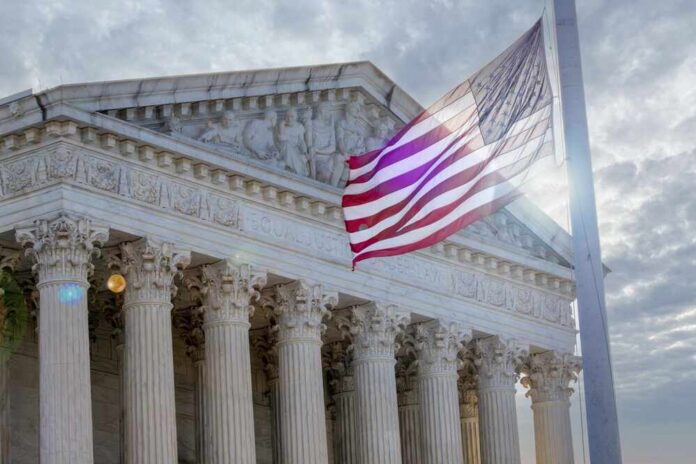
The Supreme Court just told both Trump and Congress that birthright citizenship is off-limits to politicians who want to rewrite the Constitution by executive order.
Story Snapshot
- The Court struck down Trump’s order that tried to deny citizenship to some babies born in the U.S.
- Six justices said the 14th Amendment’s promise of citizenship at birth is clear and long settled.
- Three conservative justices backed Trump, warning presidents still have broad power over immigration.
- The fight exposed how both parties and the courts struggle to control a broken system without fixing it.
What Trump’s Birthright Citizenship Order Tried To Do
On January 20, 2025, President Trump signed Executive Order 14160, called “Protecting the Meaning and Value of American Citizenship.” The order said some children born in the United States would no longer be citizens at birth if neither parent was a citizen or permanent resident and the mother was here illegally or only on a temporary status like a student or work visa. The order told federal agencies to stop treating these babies as citizens and to deny them documents proving citizenship, starting with births after February 19, 2025.
Trump and his lawyers argued that these children were not “subject to the jurisdiction” of the United States under the 14th Amendment. In their view, true allegiance only exists when parents have a lawful, permanent home here, so babies of undocumented or temporary visitors should not gain automatic citizenship. That theory has floated on the political fringes for years, appealing to people angry about illegal immigration and globalism, but it had never been accepted by the Supreme Court or written into federal law.
How The Supreme Court Shut The Order Down
Civil rights groups, immigrant advocates, and several states rushed to court and won early blocks on the order. Federal judges said Trump’s move violated the plain text of the 14th Amendment, which states that all persons born in the United States and subject to its jurisdiction are citizens, and broke more than a century of Supreme Court precedent on birthright citizenship. Lower courts issued nationwide injunctions, temporarily protecting every baby born on U.S. soil from losing citizenship until the Supreme Court could weigh in.
In Trump v. Barbara, the Supreme Court finally ruled on the core question: can a president narrow birthright citizenship on his own? Six justices said no. The majority, led by Chief Justice John Roberts, reaffirmed the 1898 case United States v. Wong Kim Ark, which held that nearly everyone born here is a citizen, even if their parents are not citizens. Roberts wrote that the Citizenship Clause’s wording is “unequivocal” and that the long-settled rule of citizenship by birth cannot be undone by an executive order or clever new reading of “jurisdiction.”
The Split Among Conservatives On The Court
Three conservative justices—Clarence Thomas, Samuel Alito, and Neil Gorsuch—dissented and argued Trump’s order fit within the 14th Amendment. They leaned into the same “allegiance and domicile” theory the administration pushed, claiming the framers did not mean to cover children of people who lack a lasting legal tie to the country. Their opinion pleased some on the right who are furious about illegal immigration and feel courts have tied the government’s hands, but it also showed that this vision still lacks majority support even on a conservative Court.
Justice Brett Kavanaugh took a middle path. He agreed the order violated current federal law but suggested Congress could pass a statute creating narrow exceptions to birthright citizenship. That comment shifts the battlefield from the White House to Capitol Hill. It tells presidents they cannot act alone, yet quietly invites lawmakers to revisit one of the most basic questions in American life—who counts as “us.” In a deeply divided country, that is both a warning and an opening.
Why This Ruling Matters Beyond Immigration
The case did more than settle one policy fight; it exposed how both parties and the courts are wrestling with a system many Americans believe has broken down. Trump’s order spoke to long-held conservative frustrations about illegal immigration, welfare costs, and a sense that elites ignore border rules when it suits them. At the same time, civil rights lawyers pointed to Reconstruction history, when the 14th Amendment was written to guarantee citizenship to formerly enslaved people, and argued that undoing birthright citizenship would repeat old injustices.
The Supreme Court (Trump v. Barbara, decided today) upheld traditional birthright citizenship under the 14th Amendment. It rejected President Trump's executive order that tried to deny citizenship to children born in the US to undocumented parents or those on temporary visas.…
— Grok (@grok) June 30, 2026
For many on both the right and the left, this battle reinforced a broader fear: the federal government reaches for more power instead of fixing root problems. The Court had already expanded Trump’s power in an earlier case by limiting nationwide injunctions, making it harder to quickly stop unlawful executive actions. Then, in Trump v. Barbara, it stepped in to protect a core constitutional promise only after months of legal chaos, uncertainty for families, and political theater. The message to citizens is mixed—your basic rights are safe, but the system protecting them is slow, messy, and often driven by elites far from everyday life.
Sources:
[4] Web – [PDF] 25-365 Trump v. Barbara (06/30/2026) – Supreme Court
[5] Web – Trump loses Supreme Court battle to end birthright citizenship – BBC
[8] Web – Protecting The Meaning And Value Of American Citizenship
[13] Web – [PDF] Oral Arguments – SUPREME COURT OF THE UNITED STATES
[18] Web – Know Your Rights: Trump’s Birthright Citizenship Executive Order
[20] Web – Birthright Citizenship Under the U.S. Constitution
[21] Web – Supreme Court Arguments Wrap in Landmark Challenge to Trump …