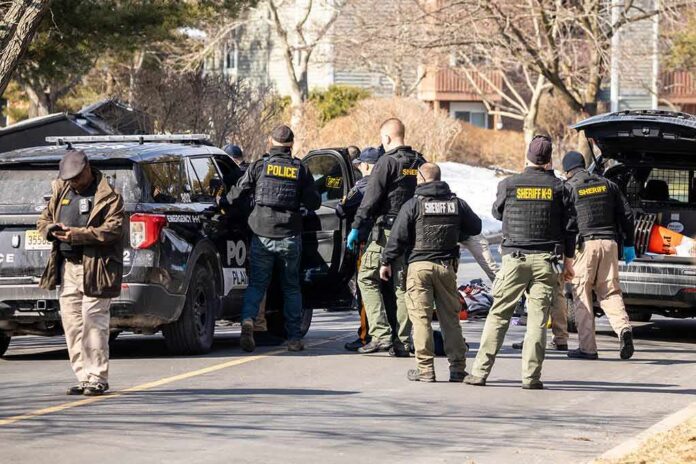
A Tennessee man who filmed Kingsport police says his videos were followed by a predawn raid and an arrest that an appeals court later undercut, and he is now suing the city and its officers for violating his First Amendment rights.
Story Highlights
- A federal civil-rights lawsuit says Kingsport police raided Joshua Gibbons’s home before dawn after he posted critical videos.
- The complaint links the raid to clips of an officer’s obscene gesture and a police sport-utility vehicle allegedly speeding without lights.
- A Tennessee appeals court threw out Gibbons’s disorderly conduct conviction, finding no evidence his words blocked lawful activity.
- A civil-liberties group is backing the suit, which targets the city, the police chief, and officers involved.
What Sparked the Lawsuit and Who Is Involved
Joshua Gibbons, a Kingsport resident who films local police, filed a federal civil-rights lawsuit in 2023 against the City of Kingsport, current and former police leaders, and several officers. The complaint says Gibbons’s YouTube videos drew public attention and anger within the department, and that officers raided his home in the early morning to arrest him soon after he posted a clip of a Kingsport police sport-utility vehicle allegedly speeding without lights or sirens. The Foundation for Individual Rights and Expression announced support for the case in 2026.
The lawsuit claims protected speech triggered government punishment. The filing cites two videos: one showing an officer giving Gibbons the middle finger, and another showing the speeding police vehicle. According to the complaint, the speeding video went up one evening in October 2022, and officers arrived at Gibbons’s home before dawn the next morning with an arrest warrant. Prosecutors charged him with disorderly conduct, speeding, and using a cellphone while driving, tying the case to events around those videos.
How the Criminal Case Ended and Why It Matters
In 2023, the Tennessee Court of Criminal Appeals unanimously reversed Gibbons’s disorderly conduct conviction. Reporting on the ruling says the judges found no evidence that his criticism stopped anyone from doing a lawful task. The decision stressed that insulting or harsh words toward police, by themselves, do not make a crime. After the reversal, the remaining charges were dismissed, clearing the path for the civil suit to focus on alleged retaliation for speech, not on guilt for disorderly conduct.
This outcome matters for two reasons. First, it undercuts the theory that Gibbons’s words were criminal, which is central to any claim that the raid and arrest were legally justified. Second, it places the dispute within a broader body of law. Courts have long held that people can record police in public and can strongly criticize officers without being arrested just for their words. Those rulings form the legal backdrop for claims that a raid like this went too far.
Why People Across the Spectrum Care
Many Americans, left and right, worry that powerful officials punish critics while dodging real problems. This case taps that fear. A citizen filmed possible misconduct and spoke bluntly. Hours later, police showed up at his door. The complaint alleges senior leadership “blessed” the raid, suggesting decisions rose above the beat level. For readers who see government as protecting its own, the timeline, the charges, and the later court reversal look like signs of a system that resists public oversight.
They filmed a sergeant speeding with no lights. The department responded with eight guns at 5 a.m. and a warrant built on a one-minute drive-thru argument. That is the case. The criminal file is already dead. The civil file is where the city pays for teaching a family that… https://t.co/2J6ftrGGmy
— Durwin Lloyd, ND (ret) (@LloydDurwin) September 24, 2026
At the same time, communities want safe streets and fair policing. Officers need space to do their jobs. The law draws a line: people can curse, film, and criticize, but cannot block lawful actions or threaten violence. The appeals court ruling says Gibbons’s conduct did not cross that line. The civil suit now asks a federal court to decide if the raid and arrest crossed the separate line that bans retaliation for protected speech.
What the Lawsuit Will Try to Prove Next
The civil case aims to show that Gibbons’s speech caused the raid and arrest. The complaint points to the close timing, the nature of the videos, and leadership approval to argue motive. Civil discovery could test that claim by seeking the arrest warrant application, internal emails, body-camera footage, and records of complaints about the videos. Those materials could clarify who made each decision, when they made it, and why enforcement followed the online posts.
Published reports so far rely on the complaint, court outcomes, and statements from Gibbons’s legal team. Kingsport officials did not offer detailed rebuttals in the coverage surfaced here. That leaves the strongest test of the city’s position to the courtroom, where records and sworn testimony can be examined. For now, the undisputed facts are the videos, the predawn arrest, the charges, and the appeals court reversal. The civil court will decide if those facts add up to retaliation.
Sources:
townhall.com, supertalk929.com, fire.org, wcyb.com