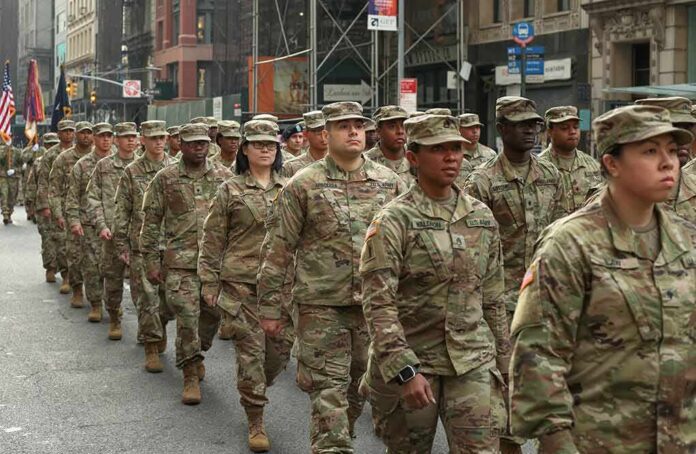
The U.S. Army is sending 1st Infantry Division troops to Lithuania as a planned rotation to deter Russia and back NATO allies.
Story Snapshot
- The 2nd Brigade Combat Team, 1st Infantry Division, will rotate into Lithuania to replace another U.S. unit.
- U.S. officials describe the move as part of Operation Atlantic Resolve and routine eastern flank deterrence.
- About one thousand U.S. troops have trained in Lithuania during recent rotations, alongside NATO forces.
- Lithuania said the next rotation is already on the way amid high regional tensions.
What Is Happening Now
Task and Purpose reported that soldiers with the 2nd Brigade Combat Team, 1st Infantry Division, will deploy to Lithuania to continue the U.S. presence on the North Atlantic Treaty Organization’s eastern flank. An Army spokesperson said they will replace the 1st Brigade Combat Team, 1st Armored Division, which recently completed its rotation. Officials in Europe and Lithuania also said the handoff is underway, keeping a steady U.S. footprint in the Baltic state next to Russia and Belarus.
U.S. Army Europe and Africa has framed these deployments for years under Operation Atlantic Resolve, which focuses on rotations, joint training, and moving armor and gear across Europe to signal resolve. The Army has highlighted earlier rotations that involved tanks, Bradley Fighting Vehicles, and artillery shifting by rail and road to support exercises and deterrence tasks. That pattern continues with the 1st Infantry Division, known as the Big Red One, taking a turn on the Baltic front this season.
Why Lithuania Matters
Lithuania borders Russia’s Kaliningrad region and Belarus, making it a key link in the Baltic defense plan. Army reporting states more than one thousand U.S. troops have operated and trained in Lithuania during recent rotations, taking part in frequent exercises with allies on local ranges and roads. Lithuania’s leaders say the new U.S. rotation removes doubts about a gap between units and supports national plans to harden defenses along the corridor that connects Poland to the Baltics.
Since 2014, the United States and North Atlantic Treaty Organization partners built a regular rhythm of deployments to the Baltics after Russia seized Crimea. Analysts describe this presence as a standing but rotating “tripwire” that reassures allies and aims to raise the cost of any attack. The setup uses multinational units led by several allies, plus separate U.S. Army rotations under Atlantic Resolve to bolster training and speed of response. The current 1st Infantry Division deployment fits that model.
How This Fits the Bigger Picture
Supporters of the rotation argue that steady U.S. units in Lithuania show commitment, improve teamwork, and keep gear and routes tested. Earlier Atlantic Resolve movements pushed heavy equipment across Europe, proving that rail lines, ports, and roads can handle large formations on short notice. Advocates say this makes any surprise move by Russia harder, and raises the risk for Moscow if it probes the alliance’s weak spots near the Baltic Sea.
1st Infantry Division soldiers deploy to Lithuania in ongoing effort to deter Russia
Soldiers with the 2nd Brigade Combat Team, 1st Infantry Division, will deploy to Lithuania as the U.S. continues its military presence on NATO’s eastern flank, Maj. Montrell Russell, an Army… pic.twitter.com/OqckXDyxtt
— Armed Forces Press (@AFP_press) September 24, 2026
Some defense studies have questioned whether rotating battalions and brigades alone can stop a rapid land grab, and have called for stronger forward forces and faster reserves. That debate continues, but the current step is not a new base or a permanent stationing. It is a planned swap of units that keeps American soldiers on the ground in Lithuania without a break in presence. Lithuanian officials underscored that the next rotation is already inbound, aligning with that goal.
Sources:
taskandpurpose.com, stripes.com, army.mil, dvidshub.net