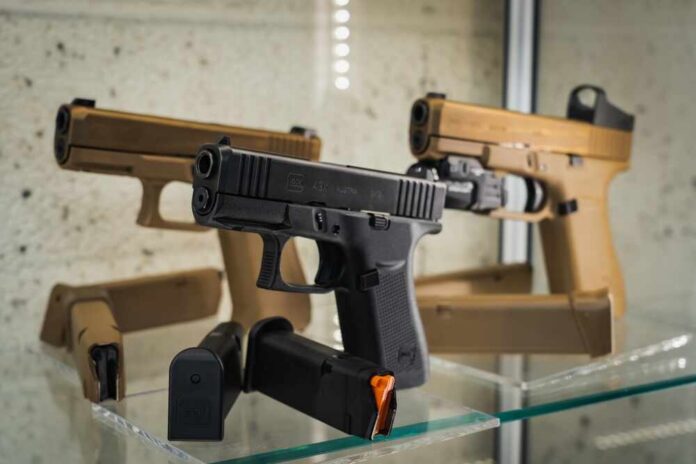
The U.S. Department of Justice gave California until June 30, 2026, to back down from a new gun law — or face a federal lawsuit over what it calls a clear violation of the Second Amendment.
Story Snapshot
- The Department of Justice (DOJ) sent a formal letter to California Governor Gavin Newsom on June 24, 2026, threatening to sue over Assembly Bill 1127 and the state’s handgun roster rules.
- AB 1127, set to take effect July 1, 2026, bans dealers from selling pistols with a cruciform trigger bar — a design found in more than 30 Glock models and over 100 other firearms.
- The DOJ says the law violates Supreme Court rulings that protect the right to own handguns in common use for self-defense.
- California says there is no “Glock ban” — only a targeted restriction on guns that can be quickly converted into illegal machine guns.
What the DOJ Is Demanding
Assistant Attorney General Harmeet Dhillon sent a two-page letter to Governor Newsom and Attorney General Rob Bonta on June 24, 2026. The letter demands that California immediately stop enforcing AB 1127, admit the law is unconstitutional, and agree to a court-enforced order banning future violations. If California refused to comply by June 30, the DOJ said it would file a complaint in federal district court.
The DOJ’s legal case rests on firm ground. A 2023 federal court ruling in Boland v. Bonta already found California’s handgun roster requirements unconstitutional. That ruling said the roster forces residents to buy outdated guns by blocking access to modern models. The DOJ also cites Supreme Court decisions in District of Columbia v. Heller (2008) and McDonald v. Chicago, which affirm that law-abiding citizens have the right to own handguns in common use for self-defense.
The “Glock Ban” Debate
California’s new law bans the sale of any pistol with a cruciform trigger bar that can be converted into a machine gun using common tools. In practice, that description fits Glock handguns almost exclusively. The DOJ says more than 30 Glock models and over 100 firearms total have already been removed from California’s approved sales list. Governor Newsom’s office pushed back hard, calling the “Glock ban” label “fake news” and insisting the law targets a dangerous mechanical feature, not a brand.
California argues that illegal aftermarket kits can quickly turn these pistols into machine guns, making them a public safety risk. That is a real concern — auto-conversion devices are illegal but widely available online. However, the DOJ counters that banning a firearm because criminals might misuse it does not hold up under constitutional law. The state has not released forensic studies or expert data to support its “readily convertible” claim.
A Bigger Pattern Taking Shape
This fight with California is not a one-off. The DOJ created a brand-new Second Amendment Section inside its Civil Rights Division in December 2024. Its sole mission is to find state and local gun laws that cross constitutional lines — and sue to strike them down. In its first six months, the section brought cases against Los Angeles County, the Virgin Islands, Denver, Colorado, and Washington, D.C.
DOJ Sues California Over Glock Ban And Handgun Roster https://t.co/8vSZizmlAl
— AmmoLand News (@AmmoLand) July 1, 2026
The National Rifle Association and the Second Amendment Foundation are already suing California over its handgun roster in San Diego federal court. Multiple legal challenges running at the same time could produce conflicting rulings and slow the process down. The Ninth Circuit Court of Appeals, which covers California, has historically sided with the state on gun restrictions — meaning any DOJ victory at the district court level could face a tough road on appeal.
What This Means for Gun Owners
For now, Californians who already own Glock pistols can keep them. The law only affects new dealer sales, and law enforcement and military purchases are exempt. But the broader handgun roster has blocked access to modern firearms for years, and the DOJ’s move signals that the federal government is done looking the other way. Whether this ends in a negotiated deal or a court battle, the outcome could reshape gun laws well beyond California’s borders.
Sources:
redstate.com, usatoday.com, instagram.com, content.govdelivery.com, oag.ca.gov, reddit.com