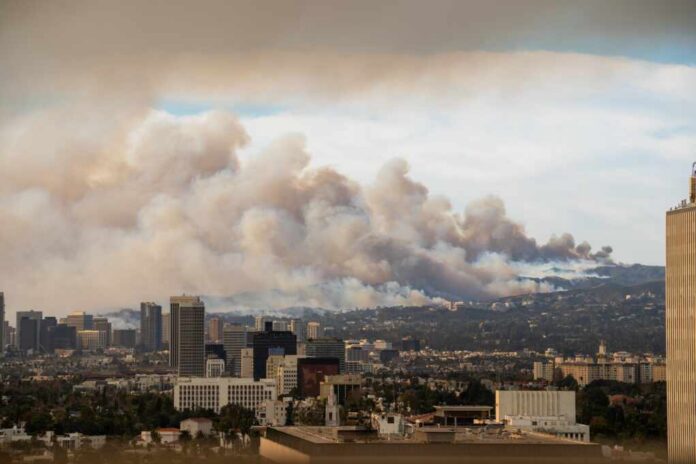
As toxic wildfire smoke from Canada again forces millions of Americans indoors, even the World Cup final is at the mercy of skies their own government cannot seem to keep safe.
Story Snapshot
- Dense Canadian wildfire smoke has pushed air quality to hazardous levels across major U.S. cities, affecting tens of millions of people.
- New York and New Jersey are under air quality alerts just days before the open-air World Cup final at MetLife Stadium.
- Health officials urge people to stay indoors and avoid outdoor exercise, highlighting serious risks from fine particles in the smoke.
- Scientists say this is part of a long-term shift toward “smokier skies,” raising questions about whether leaders are keeping up with new climate realities.
Wildfire Smoke Turns Everyday Life Dangerous Across the U.S.
Dense smoke from hundreds of Canadian wildfires has once again rolled into the United States, turning normal outdoor life into a health risk for millions of people from the Midwest to the East Coast. Detroit and Chicago recorded air quality index readings in the “hazardous” range, placing them among the most polluted cities in the world this week. In this range, officials warn everyone, not just vulnerable groups, to avoid unnecessary outdoor activity and to stay inside whenever possible.
New York City, Washington, Minneapolis and many other large metro areas woke up under eerie, orange-tinted skies as the smoke settled in. Michigan has reported some of the worst air in the country, with Detroit briefly ranked as the most polluted large city globally. Several states, including New York, Minnesota, Wisconsin, Pennsylvania and parts of New England, have issued strong air quality advisories, leading to pool closures, event cancellations and warnings that even short walks outside can be harmful on the worst days.
World Cup Final Moves Forward Under a Hazy Sky
The timing of this latest smoke wave is especially striking because the FIFA World Cup final between Spain and Argentina is set for Sunday at open-air MetLife Stadium in East Rutherford, New Jersey, just outside New York City. Organizers say they are “monitoring closely” but have not set any automatic air quality index level that would force a delay or cancellation. Spain trained outdoors in northern New Jersey on Thursday despite hazardous air readings linked directly to the Canadian fires.
Health officials in both the United States and Canada have urged residents to limit time outside and avoid heavy exercise when the smoke is thick, advice that technically applies to players and fans as well. Forecasts offer some cautious hope: meteorologists expect up to about an inch of rain on Saturday, which could wash out some smoke and improve air quality to “moderate” levels in East Rutherford by match time. Still, experts warn that conditions can shift quickly if winds push another dense plume south from burning forests in Ontario.
What Makes This Smoke So Dangerous to Health
Wildfire smoke is not just a visual nuisance; it is a mix of harmful gases and tiny particles that can reach deep into the lungs and even enter the bloodstream. The most dangerous pieces are fine particulate matter called PM2.5, so small that dozens could fit across a single human hair. The World Health Organization says PM2.5 from wildfire smoke is linked to premature death and can worsen or cause diseases of the lungs, heart, brain, kidneys, and even impact memory and thinking.
The United States Environmental Protection Agency’s guidance for public health officials warns that short-term exposure to high levels of smoke can trigger asthma attacks, bronchitis, reduced lung function and increased risk of heart failure. Most healthy adults will recover from brief exposure, but repeated multi-day events and multi-year seasons may carry risks scientists are only starting to measure. Recent medical studies show that smoke days lead to more emergency visits for breathing and heart problems, confirming what many families already feel when they see ambulance lights in smoky neighborhoods.
From Rare Crisis to New Normal: Smokier Skies as a System Failure
Scientists who track air quality say events like this are no longer rare flukes; they are part of a new pattern of transborder pollution shaped by bigger and hotter fires. One recent analysis of hundreds of monitoring stations found that wildfire smoke accounted for about one-quarter of all “unhealthy ozone days” in the United States between 2018 and 2023, with 2023 setting records largely because of Canadian fires. Another study found that the average American experienced nearly 150 days of smoke coverage in 2023, up from about 20 such days in earlier years.
𝐂𝐀𝐍𝐀𝐃𝐈𝐀𝐍 𝐖𝐈𝐋𝐃𝐅𝐈𝐑𝐄 𝐒𝐌𝐎𝐊𝐄 𝐂𝐇𝐎𝐊𝐄𝐒 𝟐𝟎 𝐒𝐓𝐀𝐓𝐄𝐒, 𝐌𝐈𝐍𝐍𝐄𝐀𝐏𝐎𝐋𝐈𝐒 𝐀𝐈𝐑 𝐐𝐔𝐀𝐋𝐈𝐓𝐘 𝐇𝐈𝐓𝐒 𝐇𝐀𝐙𝐀𝐑𝐃𝐎𝐔𝐒 𝟒𝟔𝟎
Smoke from wildfires burning across the Arrowhead region, the Boundary Waters Canoe Area Wilderness, and southern Canada… pic.twitter.com/VqLAoqsQ8R
— M.A. Rothman (@MichaelARothman) July 17, 2026
Climate researchers now describe a continent-wide shift toward “smokier skies,” as longer fire seasons and drier forests feed flames that governments struggle to control. This trend cuts across the usual political lines: Americans who worry about climate change and those who focus on energy policy or land management can all see the same haze in the air. Many feel the government, whether in Washington or Ottawa, has been slow to adjust emergency plans, stadium rules, and health guidance to match this new reality, leaving ordinary people to choose between daily life and their lungs.
Shared Frustration with Leaders as Health Alerts Collide with Major Events
For conservatives and liberals alike, this latest smoke emergency reinforces a common complaint: big promises about safety and prosperity often fall apart when real-world crises hit the ground. Americans see hazardous air alerts, canceled kids’ games, closed public pools, and now a global sports final at risk, while hearing only vague talk about “monitoring conditions” from officials. Many believe the political class focuses more on optics and business interests than on clear standards that would put health first, even if that means disrupting a major international event.
Public health experts do offer simple, practical steps families can use right now: stay indoors with windows closed on bad smoke days, run high-quality air filters if possible, and avoid outdoor exercise when air quality index levels reach “unhealthy” or worse. Those steps help, but they also highlight a deeper tension: ordinary people must change their routines because systems above them failed to prevent a known and growing threat. As smoke drifts over MetLife Stadium and millions of homes, the question hanging in the haze is whether leaders on both sides of the border will treat clean air as more than a talking point before the next big game.
Sources:
insiderpaper.com, bbc.com, npr.org, reuters.com, pbs.org, nytimes.com, cnn.com, larkscientific.org, nicb.org, youtube.com, pmc.ncbi.nlm.nih.gov, repository.library.noaa.gov, nature.com, preventionweb.net