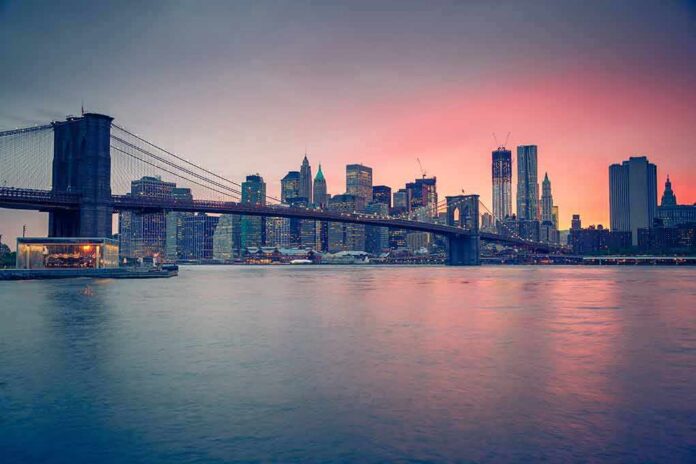
A naked man’s survival after jumping from the top of the Brooklyn Bridge has turned a viral stunt into a fresh warning about how fragile public safety—and public trust—have become in modern America.
Story Snapshot
- A 44-year-old man climbed the Brooklyn Bridge, stripped naked, jumped into the East River, and survived.
- New York City police rescued him and took him to Bellevue Hospital, where doctors said he was in stable condition.
- Officials say he faces several criminal charges, including reckless endangerment and public lewdness.
- Flags and a possible protest motive raise questions about how security and mental health are handled in high-profile public spaces.
Dramatic jump from a major landmark shocks New Yorkers
On a Sunday afternoon in early August, people walking across the Brooklyn Bridge saw something they will not soon forget. A 44-year-old man climbed up the north tower on the Manhattan side, took off his clothes, and attached several flags near the top of the span. Witnesses recorded video as he then jumped from the tower into the East River below, from a height that police have described only in general terms. The fall alone could easily have been fatal.
New York City police officers were already on the scene, trying to talk the man down before he jumped. After he hit the water, members of the New York City Police Department Harbor Unit rushed in and pulled him out. He was taken to NYC Health + Hospitals Bellevue, where medical staff said he was in stable condition. That outcome is rare; earlier reports of other Brooklyn Bridge jumps describe similar plunges as “overwhelmingly fatal” even at lower heights.
From rescue to arrest: how the system responds
After doctors confirmed he was stable, police did not simply let the man go home. New York City Police Department officials told reporters he was arrested and charged with reckless endangerment, making graffiti, public lewdness, criminal trespass, and disorderly conduct. Those charges reflect both the risk to his own life and the disruption and potential danger to drivers, pedestrians, and rescuers on a busy bridge. They also suggest the city views the flags and markings he left on the bridge as a crime, not protected speech.
News outlets have named the jumper as Galymzhan Abaildayev, a 44-year-old man with ties to activism against the government of Kazakhstan. A roommate told one newspaper that he had talked about making the leap on his birthday and framed it as a political act. That report is still based on interviews, not court records, but it has helped shape the public story surrounding the incident. It shows how quickly a single, extreme act can be pulled into global political narratives once video hits social media.
Security gaps, mental health, and a system many feel is not working
This incident highlights how easy it still is for a single person to climb a major piece of national infrastructure and turn it into a stage. New York City has spent years adding cameras, patrols, and barriers, yet officers were left trying to bargain with a man already far above the roadway. For many Americans, this feels familiar: government claims to keep people safe, but someone can still scale a landmark bridge, strip naked, and jump while officials scramble to react.
The surprising reason why Brooklyn Bridge jumper may have survived 'overwhelmingly fatal' plunge https://t.co/Ijov8SnQbd
— Churlish Insubordinate (@sparklecopy) August 4, 2026
The story also raises questions about how the country handles mental health and protest in a tense political climate. Reports describe the man as disturbed and suggest his act mixed personal crisis with political anger over events in Kazakhstan. Police had to treat him as both a patient and a suspect. Many people on the right and the left see this as another example of systems that react after the fact, with charges and hospital stays, instead of dealing with underlying stress, isolation, and distrust before someone reaches a breaking point.
Media spectacle and public frustration with “the system”
Within hours, dramatic clips of the jump spread across Instagram, Facebook, and X, often with words like “miracle” and “nutjob” in the captions. Tabloid-style outlets focused on shock value and on the man’s naked body, while others pushed the activist angle and the flags. That kind of coverage is common now: the most extreme images rise first, and careful details about police actions, medical care, or court procedure come later, if they come at all. It leaves many viewers feeling like the whole event is treated as entertainment.
For Americans who already think government mainly protects the powerful and feeds drama to the public, this pattern reinforces deep doubts. Police officers on the bridge did real, dangerous work to save a life, yet the larger system still allowed the crisis to unfold in a busy public space. Media companies earned clicks and views off a man’s near-death, while questions about bridge security, mental health care, and trust in institutions remain open. This Brooklyn Bridge jump is strange and shocking, but it also fits a wider story: a country where dramatic problems are easy to see, and real fixes remain hard to find.
Sources:
facebook.com, ndtv.com, nbcnews.com, yahoo.com, abc7ny.com, tmz.com, instagram.com, nypost.com