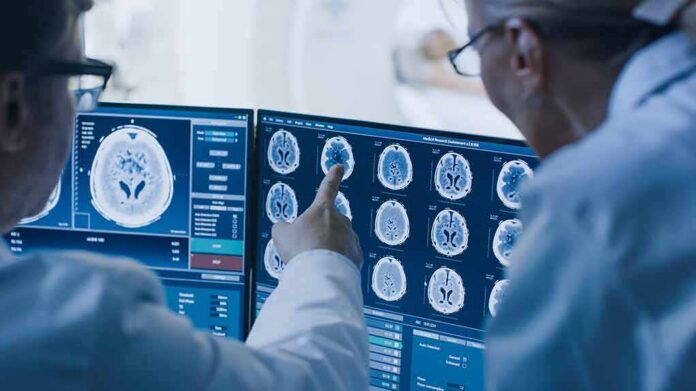
NYU researchers used focused sound waves to dial down delusions in schizophrenia after a single, targeted 10-minute session.
Story Highlights
- NYU team ran a sham-controlled crossover study with one real and one mock session per patient.
- MRI guidance targeted a deep brain node tied to thought and emotion, the globus pallidus interna.
- Delusion scores fell after real ultrasound and rose after sham, with the gap lasting one week.
- Ten patients with symptoms despite medication reported only mild, short-lived side effects.
A tightly controlled pilot aimed at stubborn symptoms
NYU Langone ran a within-person, sham-controlled crossover trial for people with schizophrenia or schizoaffective disorder who still had symptoms despite drugs. Each of the 10 participants received one active ultrasound session and one sham session on separate visits. The sham device sat on the head and turned on, but sound waves were blocked. This design let each person serve as their own control, which can sharpen signals in small studies.
Researchers used magnetic resonance imaging to guide low-intensity focused ultrasound to the right globus pallidus interna. That region helps regulate circuits for movement, thought, and emotion. The team delivered a single 10-minute sonication in the active visit. The clinical protocol and NYU report both emphasize precise targeting rather than broad stimulation, which matters when testing brain circuits linked to delusions.
What changed after one real session
NYU reported that delusion scores dropped by an average of 1.2 points after the active session. Scores increased by about 0.4 points after sham. The difference between the two conditions held through the end of the one-week follow-up window. These results point to a short-term clinical signal on a prespecified symptom domain, even in patients who were still struggling on medication.
Short-term safety looked similar between active and sham. Reported side effects included fatigue, headache, and brief increases in psychotic symptoms, all mild and short-lived. The small cohort and crossover design help compare risks within the same person. Still, any device that modulates brain activity needs careful tracking in larger groups over longer periods to rule out rare or delayed risks.
Why this matters beyond one lab
This pilot joins a growing stack of early studies on focused ultrasound in psychiatry. A separate double-blind, sham-controlled study with 26 patients reported gains on negative symptoms after 15 sessions targeting the prefrontal cortex. Reviews describe the field as promising but still early, with small samples, mixed methods, and short follow-up. The signal from NYU fits that pattern: encouraging, targeted, and not yet practice-changing.
Families and patients want options that work fast and do not require surgery. Noninvasive, image-guided ultrasound speaks to that hope. But headlines can run ahead of evidence. This study tested a single session, measured limited outcomes, and enrolled only 10 people. It does not show whether repeated sessions would yield larger or lasting benefits, or improve daily function. NYU’s own materials stress these limits and call for bigger, longer trials.
What to watch next
Researchers can build trust by releasing the full article, methods, and data alongside the clinical protocol. Larger, multisite trials should compare repeated ultrasound against sham and best standard care, with months of follow-up. Teams should test whether participants or staff could tell active from sham, and link symptom changes to brain-connectivity measures. Those steps will show whether this targeted approach can move from a lab signal to real-world care.
Ultrasound to cure schizophrenia
Scientists are actively conducting experiments using focused ultrasound (a form of sound waves) to modulate brain circuits in people with schizophrenia, with promising but very preliminary results. This is not a proven cure; it is experimental…
— Gayle Forbess (@GayLou1953) October 22, 2026
For readers who feel the system fails people with serious mental illness, this story carries both hope and caution. A precise, quick, noninvasive tool that eases delusions would relieve families and reduce hospital stays. But only careful, transparent trials can separate real progress from hype. This is how science should work: test, verify, and scale what endures—so patients are not left chasing headlines instead of help.
Sources:
nypost.com, nyulangone.org, cdn.clinicaltrials.gov, clinicaltrials.med.nyu.edu, prnewswire.com, topics.consensus.app