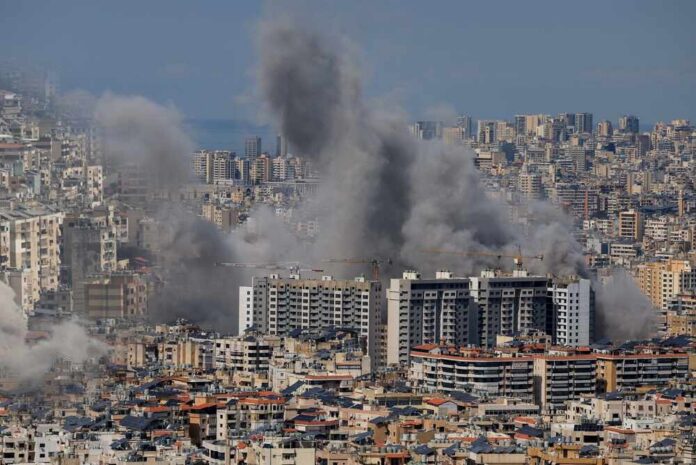
Russia’s latest massive strike on Kyiv shows how quickly a wartime “retaliation” claim can become a shield for hitting civilian cities.
Quick Take
- Russia launched a large overnight attack on Kyiv using drones and missiles, including the hypersonic Oreshnik missile [1][2].
- Ukraine reported civilian harm and damage to homes, schools, and other buildings across the capital [1].
- Russian officials and aligned commentary framed the strike as retaliation for earlier Ukrainian attacks on Russian-held or Russian territory .
- The supplied record does not resolve the core dispute over whether the earlier attack that Moscow cited justified the scale of the response [1].
Kyiv Hit in One of the Heaviest Barrages of the War
Russia hit Kyiv and surrounding areas with hundreds of drones and missiles in one of the heaviest bombardments of the war, according to the reporting provided from Ukrainian and international coverage [1][2]. The attack reportedly included the Oreshnik hypersonic missile, a weapon Moscow has used as a political signal as much as a battlefield tool . For families in Kyiv, the label matters less than the destruction left behind.
Ukrainian officials said the strike damaged residential buildings, schools, administrative structures, vehicles, and a water supply facility [1]. Kyiv authorities also reported deaths and injuries, while emergency crews worked across multiple locations in the city and nearby districts [1]. That matters because the hard facts in the record point to civilian impact first, not military precision. Whatever justification Moscow offered, the effects described in the reporting were felt by ordinary people living far from any front line.
Moscow Framed the Attack as Retaliation
Russian messaging presented the assault as a response to earlier Ukrainian strikes on civilian facilities in Russian-held or Russian territory . That argument follows a familiar Kremlin pattern: pair a brutal barrage with a narrative of punishment and deterrence, then expect the world to accept the script. The provided material shows the claim was made, but it does not supply independent forensic proof that would settle the predicate dispute in Moscow’s favor.
The reporting also shows Ukraine flatly rejected Moscow’s framing and described the Kyiv attack as a strike on civilian infrastructure [1]. That denial does not, by itself, answer every factual question about the earlier incident Russia cited. Still, the burden of proof matters, and the supplied record does not establish that Russia’s response was narrowly tied to a verified military necessity rather than a broader campaign of coercion against Ukrainian cities [1].
What the Hypersonic Missile Choice Signals
The use of the Oreshnik missile carries a message beyond raw destruction. Carnegie’s analysis of Russia’s earlier Oreshnik launch described the system as part of a wider intimidation strategy meant to send political signals, not just battlefield effects . In practical terms, that means the Kremlin can escalate while claiming it is merely answering provocation. For readers who value restraint, sovereignty, and civilian protection, that is exactly the kind of wartime logic that deserves skepticism.
Russia used the powerful hypersonic Oreshnik ballistic missile during a mass drone and missile attack on the Ukrainian capital of Kyiv, marking the third time that Russia has used the weapon in Putin's four-year war. https://t.co/hu3eDW04xP
— Kenneth Roth (@KenRoth) May 24, 2026
The broader pattern still matters. The supplied coverage places this strike inside Russia’s continuing campaign of large-scale aerial bombardment against Ukrainian urban centers [1][2]. Even if Moscow insists on a retaliatory purpose, repeated attacks on cities make it harder to accept any claim of limited force or careful targeting. The facts here support a simple conclusion: Kyiv was hit hard, civilians paid the price, and the justification remains contested rather than proven [1].
Sources:
[1] YouTube – Russia’s Deadly Oreshnik Hypersonic Missile Tears …
[2] YouTube – Russia strikes Kyiv with hypersonic Oreshnik ballistic missile