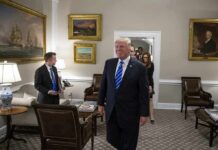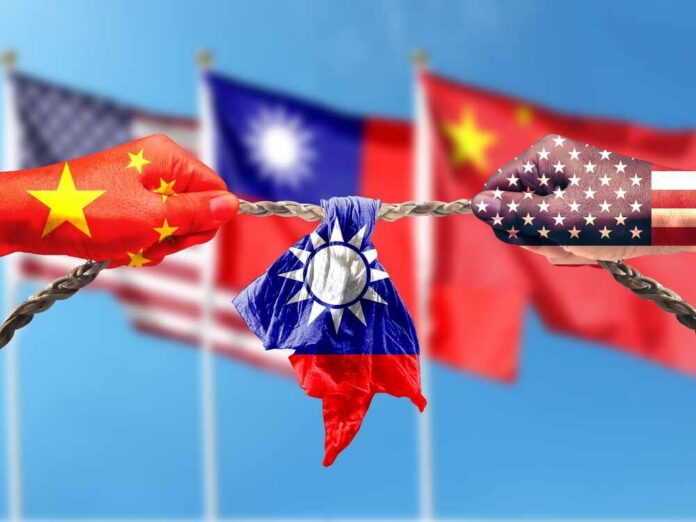
President Trump is taking America’s biggest corporate heavyweights to Beijing—turning a tense rivalry into a high-stakes negotiating table where U.S. market power is the leverage.
Story Snapshot
- The White House has invited roughly 16–17 top CEOs to join Trump on a China trip expected during the week of May 11–17, though final attendance remains fluid.
- The invite list emphasizes tech and finance leaders alongside major industrial players, signaling that trade, supply chains, and market access are central to the talks.
- Reports suggest possible commercial outcomes could include Boeing aircraft and large-scale U.S. agricultural purchases, including soybeans.
- The trip revives “CEO diplomacy” seen in Trump’s 2017 China visit, but with a sharper focus on Big Tech amid chip and AI export-control disputes.
A CEO Delegation as a Negotiating Tool
Semafor reported May 11 that the Trump White House invited CEOs from companies deeply exposed to China—including Tesla’s Elon Musk and Apple’s Tim Cook—to accompany the president on a visit expected this week. The list also included finance leaders such as BlackRock’s Larry Fink and Blackstone’s Stephen Schwarzman, plus industrial and payments executives. One limitation is that the White House has not released an official final roster, and at least one invitee declined due to scheduling.
From a conservative, “America First” perspective, the structure matters as much as the substance: bringing CEOs puts private-sector reality—jobs, exports, and investment—at the center of diplomacy rather than letting permanent bureaucracies dominate the agenda. Supporters see the approach as a way to convert U.S. consumer-market access into bargaining power. Critics, meanwhile, worry that corporate interests can blur national-security lines if market access becomes the overriding goal.
Why Tech and Finance Are Front and Center This Time
China-facing tech firms sit at the crossroads of two competing forces: Washington’s export controls on advanced chips and AI-related technology, and corporate dependence on Chinese manufacturing and sales. Global Times highlighted analysis suggesting the delegation’s heavier mix of high-tech and finance compared with 2017 sends a “clear signal” of interest in cooperation in those sectors. That framing should be read carefully, since it reflects Chinese-state media perspective even when factual details align with other reporting.
Still, the basic facts are hard to ignore. Apple’s supply chain, Tesla’s manufacturing footprint, and Wall Street’s growing China exposure create pressure for predictable rules, even as the U.S. tries to limit strategic technology transfers. The invitation strategy appears selective rather than broad-based, according to Semafor’s reporting, implying the administration wants companies most directly affected by Beijing policy at the table—where they can help identify what’s realistic and what’s risky.
What Could Come Out of the Talks: Exports, Agriculture, and Optics
Early reporting points to familiar pressure points that matter to everyday Americans: exports and industrial demand. KIRO7’s coverage referenced expectations around potential Boeing jet purchases and U.S. soybean sales, echoing the idea that big-ticket deals can quickly translate into factory workloads and farm income. The biggest caveat is timing: as of May 13, reporting indicated Trump had not yet departed and not all CEO participation was confirmed, making any “deal talk” preliminary.
Markets and corporate boards tend to respond to the direction of travel, not just signed documents. Reports in the research noted a Boeing stock bump after the invitation news circulated, illustrating how even the prospect of revived purchasing can shift sentiment. For voters frustrated by inflation and economic insecurity, tangible export orders are easier to measure than diplomatic communiqués. The political risk comes if photo-ops outpace verifiable commitments or if concessions collide with U.S. security policy.
The Political Backdrop: A Government Many Voters Don’t Trust
The trip is landing in a domestic climate where distrust of federal institutions runs deep across party lines. Many conservatives remain skeptical of globalism and corporate alignment with adversarial regimes, while many liberals suspect big business shapes policy more than voters do. That makes a CEO-centered delegation a double-edged sword: it can look like pragmatic deal-making, or it can reinforce the belief that elites get a seat at the table while ordinary citizens get slogans.
Trump doing major flex bringing tech CEOs to China: Coates | Bianca Across The Nationhttps://t.co/Fm1RTJhyUE
— ConspiracyDailyUpdat (@conspiracydup) May 12, 2026
The strongest factual conclusion from current reporting is limited but important: the administration is signaling that U.S.-China competition will be managed through leverage and transactions, not just speeches. Whether that produces durable gains depends on what is actually signed, what enforcement looks like, and whether sensitive technologies remain protected. Until the trip occurs and outcomes are published, the public should treat predictions as possibilities—not results.
Sources:
Global Times — Analysis on Trump’s CEO delegation and comparison to 2017 visit
Semafor — Trump invites CEOs of Tesla, Goldman, Apple and others to China
KIRO7 — Musk, Cook and other CEOs invited to join Trump on China trip