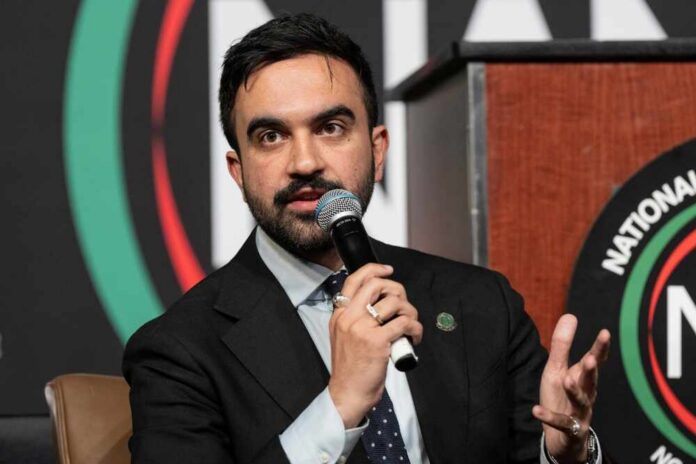
New York City Mayor Zohran Mamdani used George Washington’s desk on July 4 to redefine patriotism as “righteous dissent,” igniting a national fight over what love of country looks like.
Story Snapshot
- Mamdani said patriotism means confronting flaws, not denying them.
- He delivered the address from George Washington’s desk at City Hall.
- The speech centered on immigration and America’s “grand experiment”.
- Backlash escalated across media and activist communities.
Mamdani’s Core Message From a Symbolic Setting
New York City Mayor Zohran Mamdani marked America’s 250th birthday with a speech at City Hall. He sat at George Washington’s historic desk and spoke to newly naturalized citizens. He defined patriotism as “every act of righteous dissent” and argued true celebrations must face both ideals and flaws. He called the United States a long “grand experiment in self-governance,” praising its capacity to improve while urging honest critique as an act of love for country.
During the address, Mamdani linked national pride to civic duty. He said America “strives each day to better itself,” and he framed dissent as part of that work. He told listeners that loving a nation means refusing to “leave it” and instead choosing to fix what is broken. The mayor used inclusive language about new citizens as partners in the nation’s future. He stressed that the founding promises are strong enough to withstand criticism if people press forward together.
Immigration Focus Without Specific Data
The speech centered on immigration and belonging, themes that have divided national politics for years. Mamdani pushed back on claims that America grows weaker with each new arrival, calling that view “frail” and “uninspired,” according to press summaries. The transcript, however, did not include immigration statistics, named cases, or policy proposals. The focus stayed on values and history rather than measurable outcomes, which leaves supporters inspired but critics asking for proof.
That gap reflects a common pattern in public rhetoric. Leaders often use broad frames to define national identity while avoiding policy details that can fracture coalitions. Research shows parties have grown more polarized in how they talk about immigration, with different moral frames repeating over time. Mamdani chose a values-first frame that celebrates dissent and participation. Opponents argue that safety, law, and costs also deserve space in any honest patriotic message, and they view the omission as meaningful.
Symbolism, Patriotism, and the Founding Narrative
Delivering the speech from Washington’s desk added weight to the argument. The setting signaled a direct link to the founding era and its debates about liberty and power. Mamdani quoted language about striving toward national “perfection,” placing dissent within a tradition of course corrections. He highlighted the role of everyday people in expanding rights and opportunity. He appealed to new citizens as proof that the nation renews itself through participation and shared duty, not through silence or uniformity.
The founding frame also served as a shield against charges of disloyalty. By rooting dissent in the nation’s origin story, the mayor argued that critique is not betrayal but heritage. That claim resonates with many Americans who feel the system favors the well-connected and forgets working families. It also challenges political leaders, left and right, to meet today’s problems with more than slogans. The message: love of country demands action, honesty, and courage, even when it stings.
Backlash Underscores Deep Polarization
Reaction was swift. Major outlets highlighted controversy around the speech’s tone and focus, stressing that critics viewed the remarks as unpatriotic. Additional flashpoints around Mamdani—remarks about India’s prime minister, protests tied to disclosures involving a family member, and tense exchanges over national groups—added heat to the environment. The pile-on made it harder for the message about dissent and duty to stand alone in the news cycle.
New York City Mayor Zohran Mamdani is currently facing widespread backlash for a series of recent statements and policy directives, most notably his urgent call for residents and businesses to set their air conditioning to 78°F during a severe heat wave, his declaration that he…
— Leinona Aoki (@LeinonaA69) July 3, 2026
The uproar fits a long trend where power brokers recast dissent as disloyalty. Analysts have described how leaders use patriotic branding to mute critics and rally supporters, especially on immigration and national identity. That tactic can win short-term points but can also widen distrust. Many Americans on both sides already feel the government works for insiders first. They hear lectures about unity while seeing little progress on border management, wages, housing, and public safety. The result is more cynicism and less problem solving.
What Matters Going Forward
Two tests now loom. First, can leaders ground value-heavy speeches in practical steps that people can see and measure. Clear goals on legal immigration, border security, work permits, and community safety would make these themes real. Second, can national figures stop turning every critique into an identity fight. Building trust requires proof of work more than perfect words. If dissent is patriotic, as Mamdani said, then delivery on results is patriotic too.
Sources:
twitchy.com, cnn.com, nbcnews.com, washingtonexaminer.com, facebook.com, reddit.com, instagram.com