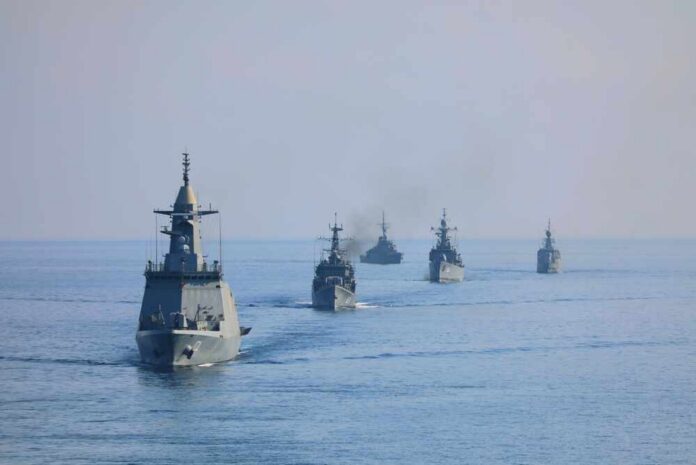
The United States and Philippines launched their largest military exercise ever on April 20, 2026, deploying 17,000 troops near contested South China Sea waters and Taiwan while Beijing issues stark warnings against what it calls “division and confrontation.”
Story Snapshot
- Balikatan 41-26 brings unprecedented 17,000 personnel from eight nations to drill near Scarborough Shoal and Taiwan-adjacent waters through May 8
- Japan deploys 1,400 troops with advanced naval assets in first major active participation, signaling expanded Indo-Pacific coalition against Chinese aggression
- Exercises test BrahMos and Type 88 anti-ship missiles in live-fire scenarios simulating counter-invasion operations at regional flashpoints
- China warns participating nations as drills demonstrate growing alliance network challenging Beijing’s territorial claims
Historic Expansion Signals Shifting Power Dynamics
The 41st Balikatan exercise represents a dramatic escalation from previous years, with 17,000 troops compared to 16,000 in 2024. Philippine Armed Forces Chief Gen. Romeo Brawner Jr. and US Chargé d’Affaires Robert Ewing inaugurated the drills at Camp Aguinaldo in Manila, emphasizing what Ewing called the “steadfast alliance” and “resolute dedication to regional stability.” The expansion reflects deepening security cooperation under the 1951 Mutual Defense Treaty and 2022 Enhanced Defense Cooperation Agreement, as partners increasingly view coordinated military readiness as essential to countering aggressive Chinese territorial expansion in contested waters.
Japan’s First Major Combat Role Reshapes Regional Alliances
Japan Self-Defense Forces deployed approximately 1,400 personnel alongside the helicopter carrier JS Ise, landing ship JS Shimokita, destroyer JS Ikazuchi, C-130H transport aircraft, and Type 88 anti-ship missiles for the first time as active participants rather than observers. This marks a fundamental shift in Japan’s regional posture following its 2022 National Security Strategy and 2024 trilateral summit commitments with the US and Philippines. The Japanese contingent will participate in live-fire exercises testing Type 88 missiles, demonstrating Tokyo’s willingness to project force beyond traditional defensive operations. This development challenges China’s narrative of regional isolation while providing practical interoperability training for scenarios involving Taiwan or disputed island chains.
Live-Fire Drills Target Contested Flashpoint Zones
Exercise locations deliberately position forces near critical geopolitical pressure points, with activities in Zambales province approximately 230 kilometers from Scarborough Shoal in the South China Sea and northern operations near Itbayat in waters adjacent to Taiwan. The drills feature precision strike training, integrated air and missile defense, counter-landing scenarios, and a live-fire sinking exercise utilizing Philippine BrahMos missiles acquired from India between 2023-2025. These sophisticated weapon systems represent a significant capability upgrade for Manila, providing coastal defense options against larger naval forces. The exercises simulate real-world conditions for repelling invasion attempts, sending an unmistakable message about collective defense commitments in waters where China has repeatedly harassed Philippine vessels and asserted illegal territorial claims.
Beyond the primary US-Philippine partnership, Australia, Canada, France, New Zealand, and the United Kingdom contribute active forces, while 13-17 additional nations including Czech Republic, Lithuania, Poland, and Netherlands observe operations. Lt. Gen. Christian Wortman, commander of US Indo-Pacific Marine Expeditionary Forces, emphasized the exercises demonstrate readiness under realistic conditions despite ongoing US military commitments in the Middle East. USINDOPACOM Admiral Paparo confirmed the exercise scale in pre-launch discussions with Gen. Brawner, reinforcing that American focus on conflicts elsewhere does not diminish Indo-Pacific priorities. This multinational coordination addresses legitimate concerns among citizens who question whether Washington’s global commitments stretch military resources too thin to effectively defend treaty allies.
Strategic Implications Extend Beyond Immediate Exercises
The unprecedented scope of Balikatan 41-26 establishes precedents for future multilateral operations and advanced weapons integration across allied forces, with long-term implications for regional deterrence architecture. China’s warnings against “division and confrontation” reveal Beijing’s recognition that expanding security partnerships undermine its ability to intimidate smaller neighbors through gray-zone coercion tactics. The exercises boost defense technology collaboration and interoperability while accelerating Indo-Pacific arms procurement among participants concerned about Chinese military expansion. For Americans frustrated with government dysfunction and elite mismanagement, these drills represent tangible action protecting national interests and supporting allies who face direct threats, rather than empty diplomatic rhetoric that characterizes too much of Washington’s typical response to authoritarian aggression.
Running through May 8, 2026, the exercises encompass ground, maritime, air, and cyber operations designed to test coalition capabilities across multiple domains simultaneously. Philippine coastal communities in Zambales and Itbayat experience temporary disruptions from military activities, while regional observers assess whether heightened readiness demonstrations increase or decrease escalation risks near contested territories. The drills fundamentally strengthen US-Philippines-Japan trilateral coordination while demonstrating that nations committed to freedom of navigation and rule of law will not be intimidated by authoritarian territorial theft, regardless of Beijing’s objections or threats.
Sources:
Philippines, US Kick Off Largest Ever Balikatan Exercises Close to Regional Flashpoints
Philippines, US open ‘biggest’ Balikatan drills
Philippines, US and Allies Launch Largest Ever Balikatan Drills Amid Rising Regional Tensions