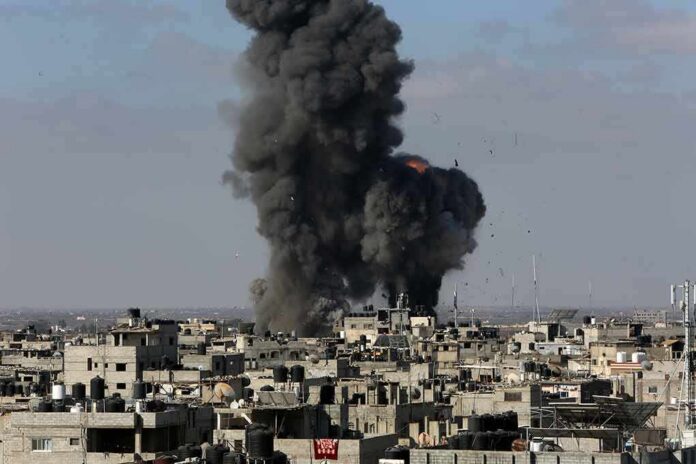
“Black rain” over Ryazan after a lethal overnight drone barrage exposes how vulnerable Russia’s oil lifeline remains—and why the fog of war still clouds what exactly burned.
Story Highlights
- Reports and video show a massive fire and oily fallout over Ryazan after Ukrainian drones struck deep inside Russia [2][3].
- Regional officials blamed “drone debris” hitting an unspecified enterprise, avoiding confirmation of a direct refinery hit [2].
- Conflicting accounts cite at least four deaths and widespread damage as questions remain about the refinery’s status [3][5].
- The strike fits a pattern of repeated hits on Russian energy infrastructure aimed at logistics and revenue [2][9].
What Happened In Ryazan And Why It Matters
Ukrainian long-range drones reportedly reached deep into Russia on May 15, igniting a major fire in the Ryazan area and showering the city with oily “black rain” after impacts near one of Russia’s largest fuel facilities [2][3]. Regional reporting and social media footage showed towering smoke plumes into the morning, while casualty reports described multiple deaths and injuries tied to strikes on residential buildings and industrial sites [3][5]. The incident underscores how energy infrastructure has become a central target and narrative battleground in this war [2][9].
Ryazan’s regional governor publicly framed the damage as the result of “drone debris” striking an unspecified enterprise and harming nearby homes, language that stopped short of naming the refinery or confirming a direct hit on refinery units [2]. Russian statements also emphasized widespread air-defense activity during a large-scale barrage, implying damage could stem from intercepts or falling fragments rather than clean penetrations [2]. Those official claims did not address the highly visible fire, oily fallout, or the precise locations inside or adjacent to the refinery complex [2][3].
Conflicting Claims And The Evidence On The Ground
Independent and exile media described a deadly outcome and a refinery blaze, citing visual evidence and local accounts that “black rain” coated parts of the city following the strike [3][5]. The Kyiv Independent reported heavy smoke over Ryazan and a massive fire after drones targeted oil infrastructure and other sites across multiple regions [2]. While Russian authorities highlighted interceptions during the barrage, they did not provide site-specific assessments of refinery process-unit damage, outage duration, or production impacts that could settle the dispute [2][3].
The immediate information gap reflects a familiar wartime pattern: dramatic imagery arrives first, while hard confirmation about facility-level consequences lags behind or remains obscured by competing narratives [2][3]. Without operator statements, satellite assessments, or verified outage data, the public record leaves key questions unresolved. Still, the scale of the fire and the reported oily precipitation suggest a significant hydrocarbon event in or near the refining complex, even if the exact ignition point is not yet publicly documented [2][3].
Strategic Stakes: Fuel, Frontlines, And Information Warfare
Targeting refineries can squeeze Russia’s domestic supplies, raise logistics costs, and cut hard-currency earnings from exported products. Reporting in recent months has tracked a broader campaign of strikes on Russian oil sites, with April 2024 noted as an intensifying period of such attacks, reinforcing the strategic logic behind deep strikes like Ryazan [2][9]. Ukraine’s message to Moscow is clear: critical energy infrastructure far from the front is not immune, and each successful hit forces expensive repairs and defensive reallocation [2][9].
A Ukrainian drone attack hit an apartment building in Ryazan, Russia on Friday, leaving four people, including a child, dead.
Ukraine said it had struck a Russian oil refinery in Ryazan. #russia #ukraine #conflict #drone pic.twitter.com/BYQ8NwT1tY
— CGTN Europe (@CGTNEurope) May 16, 2026
For American readers, the takeaway is twofold. First, this is a textbook example of how modern conflict blends kinetic effects with perception management; early claims will clash, and truth emerges with evidence, not slogans [2][3]. Second, disruptions to global refining capacity—even inside Russia—can ripple into energy markets. Conservatives who remember energy shocks know why hardened infrastructure, transparent reporting, and realistic production planning matter. Strong borders, strong industry, and clear-eyed leadership remain the antidote to volatility at home.
Sources:
[2] Web – Massive fire erupts at Russia’s Ryazan oil refinery as Ukrainian …
[3] Web – Ukrainian drone attack kills four in Ryazan, igniting refinery fire …
[5] Web – Ukrainian Drones Kill 3 and Set Ryazan Oil Refinery Ablaze
[9] YouTube – Massive Fire Erupts At Ryazan Oil Refinery After …