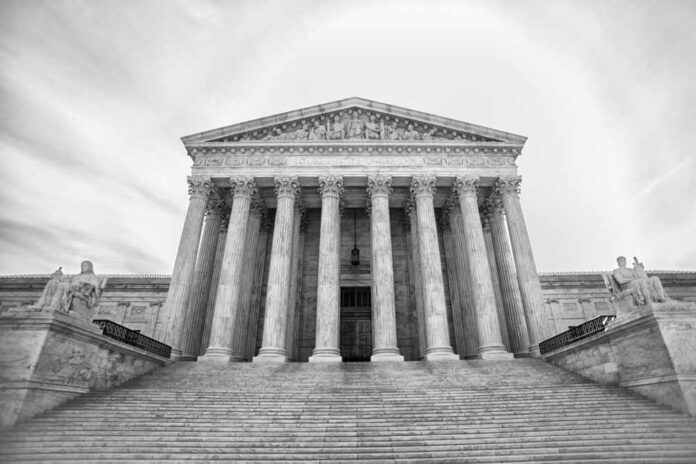
A unanimous Supreme Court just slapped down the Fourth Circuit for expanding liability beyond the Constitution’s limits—again.
Story Highlights
- The Supreme Court unanimously reversed the Fourth Circuit in Cox v. Sony, rejecting “mere knowledge” as a basis for contributory liability [2][3][5].
- The Court held that intent—not passive awareness—is required to pin secondary copyright liability on a service provider [2][4][5].
- The Fourth Circuit’s judgment was reversed in part, vacated in part, and remanded, confirming the breadth of the correction [6].
- The ruling protects general-purpose internet services with substantial lawful uses from being treated as de facto infringers [2][4][5].
Supreme Court Narrows Expansive Liability Theory
The Supreme Court ruled that contributory copyright liability requires evidence the defendant intended its service to be used for infringement, not merely that it knew some users infringed and continued operations. The opinion rejected the Fourth Circuit’s knowledge-and-continuing-service approach as going beyond recognized theories of secondary liability. The decision reversed a massive verdict and re-centered the standard on intent rather than passive awareness, closing the door on lawsuits that punish lawful services for unlawful user behavior [2].
Summaries of the ruling explain that the Justices unanimously rejected a “mere knowledge” theory, aligning the law with long-standing principles that protect innovation and neutral tools. By emphasizing intent and inducement, the Court clarified that plaintiffs cannot convert a broad notice regime into strict liability for service providers. The decision reaffirms that liability must be tethered to purposeful facilitation of infringement, not the unavoidable reality that some users may break the rules online [4].
Court Affirms Protection for Lawful, General-Purpose Services
The Court recognized Cox’s internet service as a general-purpose tool with substantial noninfringing uses, a critical factor that undercuts efforts to criminalize or civilly penalize standard network access. Legal commentators noted that the ruling narrows secondary liability and protects commercially significant lawful activity from being chilled by broad theories of blame. This reasoning insulates ordinary platforms and connectivity providers from outsized penalties when they are not intentionally promoting infringement [3].
Practitioner analyses further report the unanimous nature of the reversal, highlighting how the Fourth Circuit’s approach conflicted with settled doctrine. By restoring an intent-focused standard, the Court sent a signal to lower courts that expansive, results-driven liability theories cannot replace precise legal elements. That clarity matters for businesses, consumers, and constitutional limits on judicial overreach, which demand fair notice and predictable standards before imposing extraordinary damages [5].
Procedural Outcome Confirms Breadth of the Correction
The Fourth Circuit’s own docket reflects that the judgment was “reversed in part, vacated in part, and remanded,” underscoring the depth of the Supreme Court’s correction. That procedural disposition means the appellate framework used below cannot stand as written and must be reworked under the high Court’s intent requirement. The case returns for further proceedings constrained by the clarified standard, a practical check on expansive liability experiments that risk punishing lawful providers [6].
The reporting available does not include the full Fourth Circuit opinion or party briefs, limiting definitive conclusions about whether the panel ventured beyond the issues as presented. However, the unanimous reversal on the core legal theory places a clear boundary: courts cannot transform awareness plus continued service into contributory liability for a neutral, general-purpose product. For everyday Americans, that safeguard protects free-flowing communication, consumer choice, and the innovation that keeps costs down and options open online [2].
Why This Matters for Liberty, Markets, and Speech
Expanding secondary liability through “mere knowledge” invites pressure campaigns that could force providers to police and terminate users broadly, chilling lawful speech and raising compliance costs that hit families and small businesses. By insisting on intent, the Supreme Court guarded due process, limited government-style coercion by litigation, and the free-market conditions that power American prosperity. The message to lower courts is simple: follow the law as written and proven—not ideological shortcuts or guilt by association [4].
Sources:
[2] Web – Supreme Court Unanimously Reverses Fourth Circuit in Cox …
[3] Web – Supreme Court Reverses $1 Billion Verdict, Rules Cox Not …
[4] Web – Supreme Court Reverses Cox Communications Copyright …
[5] Web – Supreme Court Rejects “Mere Knowledge” Standard for Contributory …
[6] Web – U.S. Supreme Court Narrows Secondary Copyright Liability and …