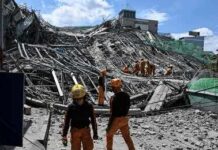
A deadly week of earthquakes from Venezuela to California has sparked wild “global trigger” claims, but the science tells a very different story.
Story Snapshot
- Four major quakes hit Venezuela, Japan, and California within hours, plus damaging quakes in Afghanistan and the Philippines.
- Seismology experts say these earthquakes occurred on separate fault systems with no physical way to trigger each other.[4]
- Venezuela’s rare double quake caused mass deaths, while Japan and California saw strong shaking but far fewer casualties.[5][11]
- Media and social platforms hype “mystery clusters,” but global data shows such timing can still be random.[7][18]
Deadly Venezuela Double Quake Caps a Violent Global Week
Two powerful earthquakes struck Venezuela just 39 seconds apart, making this nation the tragic center of a week of global shaking.[11] The first Venezuelan shock registered around magnitude 7.2, with the second larger main shock near 7.5, both tied to the same fault system off the country’s northern coast.[5][11] Early reports counted at least 164 dead in Venezuela, with later tallies climbing into the hundreds as rescue teams reached collapsed neighborhoods.[6][11] Families were left homeless, infrastructure was shattered, and the scale of damage was compared to past major quakes that struck unprepared regions.[10][11]
While Venezuela was reeling, Japan and California were also shaken by strong quakes within the same roughly 24-hour window.[1][4] A magnitude 6.9 earthquake struck off northeastern Japan, sending intense shaking through Iwate Prefecture and forcing bullet trains to halt, yet strong building codes and preparedness kept deaths and major injuries near zero.[7] Northern California was hit by a magnitude 5.6 quake near Redwood Valley, with injuries and power outages but no reported fatalities.[1][5][7] Afghanistan and the Philippines also saw damaging tremors reported in the same broader week, adding to the sense of a planet under stress.[2][7]
Experts: Separate Faults, Separate Plates, No Global Trigger
Scientists who study earthquakes for a living are clear: these events did not trigger one another.[1][4] UCLA geotechnical engineer Martin Hudson explained that the Japan and California quakes were nowhere near close enough to transfer stress to the Venezuelan fault system.[4] University of California, Berkeley seismologist Angela Lux said the California quake did not affect Venezuela’s quake because of the vast distance between the faults.[5] California, Japan, and Venezuela lie on different plate boundaries, with Venezuela’s faults tied to the Caribbean and South American plates, not the so-called Pacific Ring of Fire system that includes Japan and California.[2][4]
Seismologist Lucy Jones of the California Institute of Technology told reporters that large earthquakes thousands of miles apart do not raise the chance of another major quake elsewhere.[3] She stressed that each large quake happens where stress has built up on known plate boundaries over decades or centuries, not because another country shook earlier that day.[3] Indonesian seismologist Daryono echoed this, noting that earthquake sources across the globe are numerous, and when they happen close together in time it is coincidence, not a chain reaction.[2] Dynamic stress waves can gently “nudge” distant faults, but the energy is far too small to rupture major faults on other continents.[1]
Why Clustered Quakes Feel Suspicious — and What the Data Shows
Many people look at four strong quakes on three continents in less than 24 hours and feel that it cannot be random.[1][12] Social media posts and viral videos push “Did Venezuela’s quakes trigger California and Japan?” narratives, asking if scientists are hiding a larger pattern.[1][3] Mainstream outlets sometimes describe the week as a “rare and powerful string” or an “unusual cluster,” language that feeds suspicion even when they also quote experts saying the quakes are unrelated.[5][14][18] For grieving families in Venezuela, a simple “coincidence” answer can sound cold or dismissive, which makes them more likely to doubt official voices.[6][10]
Global earthquake catalogs and recent research paint a calmer picture.[7][17][18] Studies that examine worldwide seismic records find that background earthquakes follow patterns that can look clustered in time without any direct physical link between distant faults.[17][19] Researchers analyzing long-term data for great quakes have shown that even apparent global clustering of magnitude 9 events can be explained as part of a random process.[18] A recent study using machine learning found “critical” clustering patterns only within local foreshock sequences before some large quakes, not across oceans between separate plate systems.[21] In plain terms, several big quakes can hit in one day without sharing a cause.
Real Lessons for Conservatives: Preparedness, Not Panic
This week of shaking carries a hard lesson that fits long-standing conservative concerns about honest risk and smart spending. Venezuela’s horror shows what happens when corrupt or weak governments ignore building standards, disaster planning, and basic infrastructure for years.[10][11] Japan’s outcome, by contrast, shows how serious engineering and clear rules save lives even when the ground moves hard.[7] California’s quake was a warning that our own country cannot rely on luck; older bridges, schools, and hospitals in blue-run cities may not be ready for the “big one.”[7][10]
Earthquakes strike Venezuela, Japan, Afghanistan, Philippines and California in deadly weekhttps://t.co/M7MfHwV1j4
— Insider Paper (@TheInsiderPaper) June 27, 2026
For American families who value self-reliance, the main takeaway is simple: do not let hype about a “global trigger” distract from tangible local steps. Scientists agree that the Venezuela, Japan, Afghanistan, Philippines, and California quakes were not part of a secret geo-engineered plot or a coordinated natural chain reaction.[1][2][3][4][5] But they also warn that strong earthquakes will keep coming along known faults. That means pushing state and local leaders to invest in real resilience, cut wasteful pet projects, and focus on safer structures, emergency plans, and clear communication — before the shaking starts.
Sources:
[1] Web – Earthquakes strike Venezuela, Japan, Afghanistan, Philippines and …
[2] YouTube – Did Venezuela’s Twin Earthquakes Trigger Japan & California …
[3] Web – A series of powerful earthquakes shook several parts of the world …
[4] YouTube – 4 Earthquakes Rock Three Continents In Less Than 24 Hrs
[5] Web – Did the tremors in California and Japan trigger a pair of earthquakes …
[6] Web – Several strong earthquakes strike globally in 1 day. How are they …
[7] Web – Massive earthquakes hit Venezuela, Japan, CA in 8 hours
[10] Web – VENEZUELA QUAKES FOLLOW QUAKES IN CA & JAPAN – Facebook
[11] Web – Venezuela quake: Devastation is urgent warning for California
[12] Web – 2026 Venezuela earthquakes – Wikipedia
[14] Web – Four powerful earthquakes struck Venezuela, Japan, and California …
[17] Web – New information overnight after strong earthquakes hit California …
[18] Web – Earthquake pattern analysis using subsequence time series clustering
[19] Web – Recent research and recent quakes reveal surprises in major fault …
[21] Web – Global Patterns of Earthquake Clustering – Frontiers