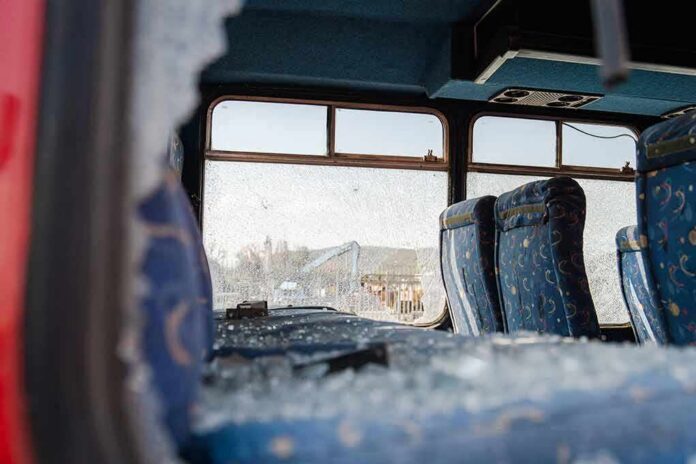
Police say a MARTA bus driver fell asleep at the wheel before the bus crossed lanes and slammed into a tree in Dunwoody.
Story Snapshot
- Dunwoody police said the driver fell asleep before the crash and issued charges.
- Inside-bus video showed the driver nodding off and missing signals before impact.
- The bus crossed multiple lanes and hit a tree; three people were injured.
- MARTA said it is reviewing the incident and removed the operator from service.
Police Account and Charges
Dunwoody Police reported that the MARTA driver fell asleep at the wheel on September 7, 2026, before losing control. The bus crossed lanes on North Shallowford Road near Peachford Road and struck a tree. Police said the driver was charged with distracted driving and failure to maintain lane. A police sergeant stated the driver “fell asleep at the wheel” and could not regain control before the crash.
Local reporting based on the police statement said three people were on board. The driver and two passengers suffered injuries, though the exact severity was not detailed. Some outlets said two passengers complained of injuries and the driver went to the hospital. Those accounts align on the core point: all three occupants were hurt in the crash sequence that ended at the tree line off North Shallowford Road.
What Bus Video Showed Before Impact
News outlets aired video recorded inside the bus in the minutes before the collision. The footage showed the driver missing a green turn signal and receiving an automated alert designed to get his attention. The driver appeared to nod off again, with hands off the wheel, shortly before the bus drifted across lanes. The final moments showed the bus veer off the roadway and into trees near the intersection area described by police.
The clip’s timing details in those reports placed the struggle to stay alert around late morning, shortly before 11:10 a.m. The sequence remained consistent across outlets: an initial missed cue, a warning, and then a second lapse. While full raw footage and police reconstruction files were not published alongside the stories, the aired segment and police summary matched on drowsiness leading into loss of control.
MARTA’s Response and Safety Review
The Metropolitan Atlanta Rapid Transit Authority said it was reviewing the crash and stressed that rider and employee safety is a top priority. Reporting said the agency removed the operator from service during the review. Agencies often secure vehicle data, camera files, and logs after an event like this. MARTA did not release the driver’s identity or any medical information, which is common during active reviews and personnel actions.
Officers are on scene investigating a crash involving a MARTA bus near Langhorn Street on Wednesday night, according to the Atlanta Police Department. https://t.co/sZPQrpwYBk
— FOX 5 Atlanta (@FOX5Atlanta) September 17, 2026
Public updates so far focus on immediate facts: the date, the place, the video clip, and the initial charges. Officials did not publish the full crash report, medical findings, or toxicology. That is routine at this stage and does not change the near-term safety takeaways. When an operator appears to fall asleep on duty and a vehicle crosses lanes into a fixed object, agencies typically examine work hours, rest breaks, and alertness systems to reduce repeat risk.
Why Fatigue on Transit Matters Beyond This Crash
Transit safety research ties longer driving hours and weak recovery time to a higher crash risk. A joint study by MITRE and several bus systems found collision rates rose with longer shifts, and that fatigue is a potential hazard in many bus crashes. Federal transit guidance says agencies should check sleep length, time awake, circadian timing, medical issues, and vehicle data before they conclude fatigue caused a crash. Those steps help turn headlines into fixes.
What Riders and Taxpayers Should Watch Next
Riders and taxpayers should watch for concrete actions, not slogans. Key items include the full police crash report, the bus’s camera and event data, and a MARTA summary of schedule and rest-time checks. Transparent findings can drive better staffing, smarter shift design, and stronger in-cab alerts. That is how a frightening video becomes a safer system. MARTA’s review and any cited policy changes will show whether this moment leads to real safety gains.
Sources:
facebook.com, 11alive.com, abc7ny.com, local12.com, fox5atlanta.com, rosap.ntl.bts.gov